Showing posts with label pasta. Show all posts

Tuesday, September 7, 2010

Mangiafagioli

“What I love about cooking is that after a hard day, there is something comforting about the fact that if you melt butter and add flour and then hot stock, it will get thick! It’s a sure thing! It’s a sure thing in a world where nothing is sure…”
--Nora Ephron, Heartburn

I went to Venice last weekend. It was… I don’t have words. Or rather, I have too many words, and it’s going to take me some time to figure out which ones I want to use, so I’m afraid those of you reading this will have to be patient in waiting for the post(s) on La Serenissima. But it was amazing.

I left in a hurry on Friday, after school and a thoroughly delightful but longer-than-planned farewell lunch for a classmate. (Note to self: aperitivo + gnocchi + hot afternoon sunshine on Piazza Brà = a sluggish Buongustaia.) Starting with the mad dash from my apartment to the Verona train station, and ending with the mad dash through inscrutable Venetian alleyways to catch the last train home, the weekend was a nonstop blur of activity. I will spare you the lamentations for my poor, achy, blistered little feet, because the weekend was worth every blister! I had school Monday morning, of course, and after class, I was still groggy and sore. No energy to go out about town, and besides, I had things to do at home. The day was cool and overcast—almost no sunshine. Best way to fight the cloudy-day blues and post-travel fatigue? Cook!

One of my favorite cool-weather comfort foods is pasta e fagioli—pasta and beans. It’s warm and nourishing and soothing, like all the best soups, but it’s not quite a soup. When I had it in Rome it was beans and noodles and vegetables in a clear broth, soup-like, but in Northern Italy it’s more like a porridge, with the beans mashed, or simply cooked to the point of dissolution, to thicken the broth. In fact, the more I see of this dish in the North—both Tuscany and the Veneto claim it as their own—the more I think that the Roman version was gussied up for restaurant service, and not at all a typical preparation. But it was still delicious.

Borlotti are the beans traditionally used for this dish; in the US, cranberry beans make a fine substitute (they are similarly colored, white with rosy mottling). Pinto beans work in a pinch—I like them better than either cannellini or kidney beans, for color and texture—or you can use chickpeas and call it pasta e ceci. I actually already had a can of borlotti beans in the cupboard, thinking that, as the weather turned cooler, I might want to make this. But when I went to the vegetable market, they had fresh borlotti, and since they are in season, how could I pass them up?

I hadn’t been to the vegetable stalls in several days, since I needed to use up the produce I already had before leaving to Venice. It was, as always, fun and informative. I started with the carrots. The vendor bustled over and swatted my hands away. I was surprised, because normally customers are allowed to select their own vegetables. But she said, “Wait a minute—these carrots are no good. Let me get them out of the way for you.” She picked through the bin and selected half a dozen cracked or limp carrots, which she then laid to the side, and said, “There you go. Those others were ugly. These are beautiful. Go on, pick the ones you want.” So I did. And then I reached toward the celery: sturdy bunches with full heads of thick, dark green leaves. “You’re making a broth?” asked the vendor. I nodded, and she snapped two crisp stalks off at the root end and put them in the bag with the carrots. (This is totally brilliant, because while I like celery I don’t use it in that many things, and when I have to buy a whole bundle invariably it goes bad before I can use it all. Buying by the stalk is really ideal. Why don’t American grocers let you do that?) Next, “You need some onion.” This was not a question. “Red, white? How many?” “One white, please.” Garlic, or anything else? No, I had all that at home.


Pasta e fagioli is very easy to make, although it can be time-consuming. I usually make one of three versions: very slow, very fast, or not-too-slow.

The very slow version simply means that I start with dried beans and soak them and boil them. It takes hours, but then you get a bean broth, and it’s much tastier than canned beans. If I’m in a SlowFood mood, I also use homemade broth and (as I had it in Rome) scraps of fresh pasta dough instead of dried noodles.

The very fast version goes like this: Heat up some broth (chicken or veg, depending on your persuasion). Boil pasta in it. Whatever kind of pasta you have on hand. Smaller, shorter is better. If all you have is spaghetti or other noodles, just break them into little bits. When the pasta is cooked, add canned beans that have been rinsed and drained. Simmer a couple minutes until it’s all heated through, then season with salt and pepper, serve with a little olive oil and parmesan on top. It's a pale imitation of the real thing, but it’s still very tasty, and a great quick supper—takes barely 15 minutes, and I nearly always have the ingredients on hand.

The not-so-fast version makes a concession to the use of canned beans, and takes a little more patience than the fast-food version, but is more delicious and satisfying:

Start with a soffritto of onion, carrot, celery, and a couple cloves of garlic. There should also be herbs; at home I might use thyme, oregano and/or bay leaf, but since I didn't have any of that on hand I just used the celery leaves.


I need to take a moment here to say a few words about celery leaves. We’ve all had them in our kitchens, pretty much, because when we buy a bunch of celery it usually comes with the leaves. And most of us throw them away! Please, dear readers, do not neglect your celery leaves. They are fresh and herbaceous and aromatic and delicious. You can put them in salads (example: thin slivers of celery stalk, shavings of Parmesan, chopped celery leaves and parsley, dress with lemon juice and olive oil), or you can chop them up and throw them in with your soffritto or mirepoix or whatever cooking base you use. I always put celery leaves in my stocks. You can use it like any other herb in dressings, sauces, or even soft cheeses and compound butters. For example, there is a poem attributed to Vergil that describes a peasant’s lunch of cheese seasoned with garlic, oil, vinegar, salt, coriander, rue and comas apii graciles—celery’s delicate tresses. Delectable.

Anyway, back to our pasta e fagioli. Optional additions to the soffritto: a little tomato paste, a little lardo or guanciale, or, if you’re daring, a pinch of hot red pepper flakes. Add broth or water, bring to a boil. Add the beans (rinsed and drained, if using canned; if using dried beans, add their cooking liquid too). Once the beans are heated through, this is the step where you mash the beans, if you want a thick soup. At home I use an immersion blender and give it a few quick pulses, not enough to purée the whole thing, just to break up about half the beans. La nonna would use an old-fashioned food mill. If you don’t have either of these implements, a potato masher works just fine. Naturally, the immersion blender goes straight in the pot, but if you want to use a mill or masher, take out about half the beans with a slotted spoon, mash them and then add them back in.

If you have enough broth, and depending on how soupy you want the dish you be, you can cook the pasta directly in the pot. I personally prefer to do it this way, as I’m a fan of one-pot meals, especially on busy weeknights. You can also cook the pasta separately, in salted water, and add it already cooked to the pot of beans. (This is also a terrific way to use up leftovers, if you have some plain cooked noodles lying around.) Once everything is cooked through and quite hot, check the seasoning, ladle into bowls, and dress with a drizzle of olive oil, black pepper and Parmesan.


This is the first time I’ve made pasta e fagioli with fresh beans, and they took almost an hour to cook—but still, much faster than dried, and with a creamier texture and subtler flavor. I made a big pot so I’ll be eating it all week, but I don’t expect to get tired of it anytime soon!

Oh, and let's not forget dessert:

Wednesday, September 1, 2010

Mantua, Part II

I mentioned earlier that Verona is in the region of the Veneto. Mantova is just over the regional border in Lombardia (Lombardy), and even though it’s only a half-hour train ride away, it’s a different culinary world. Lombard is probably best known for its rice dishes and stuffed pastas, and for a sparkling red wine called Lambrusco.

First stop on our foodie tour was this beautiful pastry shop:


We picked up an assortment of goodies to sample. We brought them back to Verona and by Monday had devoured them all: sbrisolina, a cornmeal shortcake, crumbly and not too sweet, with a pleasant savory counterpoint from the whole roast almonds contained in it; a delectable conchiglia (shell-shaped pastry) filled with chocolate and pears; an offella (tartlet) containing a dense, sweet layer of quince paste; a capricciosa (diamond-shaped pastry) with cherries and cream. The most foreign-to-us item was the torta di tagliatelle, composed of fine, slightly crunchy egg noodles layered with a buttery, sweet-spicy filling. Most of you reading this already know that I dabble in culinary history—it’s only natural that my personal interest in food and my scholarly interest in history and cultural studies would intersect, no? Anyway, the combination of the noodles and sweet-spiced filling reminded me of some sixteenth-century pasta recipes. In the cookery books by Cristoforo di Messisbugo (the majordomo of the Este palace in Ferrara, early 1500s) and Bartolomeo Scappi (head chef for Pope Pius V, Rome, mid-1500s), there are a number of variations on this theme: fresh noodles or gnocchi (dumplings), made with or without egg, seasoned with butter, sugar, cinnamon and cheese. This includes layered pasta dishes, such as lasagne. (Sound peculiar? I’ve tried making a couple of these recipes and they’re unexpectedly delicious.) This sweet may very well be a direct descendant of those preparations. I found several websites with recipes and descriptions of this sweet, but none of the ones I've seen so far attempt to trace its history. There seems to be some debate as to whether the torta should have a short-crust base or not (the one we had didn't), but that aside, all sources agree that the key ingredients are fresh egg noodles, preferably homemade, with a filling of butter, ground blanched almonds, sugar and cinnamon. I might take a crack at making this someday—funny, I never thought I’d use my pasta machine to make dessert!

On the walk to the Teatro Bibiena we’d passed a couple of food shops and eateries (including, disconcertingly, a McDonald’s), so after our pastry-buying binge we turned back along Via Accademia to investigate.

First was a very charming combination of delicatessen (La Boutique del latte—the milk boutique) and bookstore (Il Pensatoio – la librogusteria—The thinkery – the book-tastery?). The food side had mostly cheeses, plus wines and local specialty products; the book side had fabulous art books and cookbooks and novels and music and movies. If the academic job market is still slumping by the time I graduate, maybe instead I should think about opening a shop like that one…

Even though the point of this whole trip is to get friendly with Italian language-culture-gastronomy, when I saw the fabulous display of French cheeses, I couldn’t resist it. They had a Coulommiers, which is one of my very favorites: a gloriously stinky creation that I have never yet been able to find in the US, even in specialty cheese shops. It reeks of a barnyard and tastes of an earthy paradise. This one was quite mature, with a rind that was more blush than white. Darlingtonia had never encountered this cheese before, and we decided that such an aggressively smelly delicacy simply had to be introduced into her gastronomic curriculum. For when else, after all, would she next have an opportunity to taste it? Despite my warnings and the potent aroma emanating from the shopping bag, I am not sure that she was quite prepared for its pungency. Even I had to trim the excess rind from the slices I ate—and I was raised to believe that it is anathema to cut the rind off a soft-ripened cheese! Our beloved home state of California produces some exquisite cheeses, but none are as bracingly pungent as the good French stuff, and I sometimes think that, just as I’ve lost my tolerance for humid summers and snowy winters, my tastebuds have gone soft, too accustomed to the plush luxuriance of a Mt. Tam or a Humboldt Fog. We Americans are starting to pull away from our Puritanical roots where food is concerned—witness the rising triumphs of SlowFood and nose-to-tail eating—but even though we’re eager to sample artisanal breads, heirloom vegetables and heritage livestock, even though we quaff biodynamic wines and obsessively hunt down single-origin chocolates, we are still a little fearful, I think, of soft-ripened cheeses that are authentically and intensely stinky, redolent of humus and decay. Oh, sure, you’ll come across the occasional Epoisses or Pont L’Eveque, but most of what’s fit for USDA-certified importation is bound to be on the milder end of the pungency scale. And besides, there’s something naughty about eating these cheeses…something dirty, almost transgressive. We shouldn’t be putting our mouths near anything that smells like that—and yet we do, and what’s more, we love it, we keep on doing it, we crave it.

Whew. Sorry for the digression. Ricominciamo:

We didn’t actually eat the cheese in Mantova. We brought it back to Verona and had it before dinner the next night. But we did want a snack before going in search of our dinner, and we passed by an enoteca (wine bar) with a tantalizing display of hors d’oeuvres piled all along the bar. A crowd was starting to gather, so we popped in to see what the deal was. It was a very good deal. For €4 each we got a glass of excellent dry Prosecco, and were at liberty to sample as much as we wanted of the appetizers:

schiacciata (flatbread) with tomatoes
herbed green and black olives
frittata
mortadella di Bologna
Parmiggiano-Reggiano cheese, in chunks
crostini: salame; shrimp; tuna; cheese and wurstel (a thin, bratwurst-style sausage)
bocconcini (tiny sandwiches) of salame and mortadella
tomato bruschetta
salad of zucchini, cheese and wurstel
carrot sticks
pasta salad
rice salad

I wish this setup would catch on in American bars; it’s brilliantly simple, economical (because no wait-staff is needed) and convivial. The enoteca drew singles, couples, even families with small children! And if you didn’t want to crowd around the bar, you could fix yourself a plate and enjoy your wine and snacks at an outside table.


We didn’t eat much because dinner was imminent, but we did sample a few bites and they were all very tasty. Then onward to the restaurant, Hosteria Leon D’Oro, which promised authentic Lombard cuisine. We sat outside in a picturesque alleyway and were given handwritten menus. There was a two-page preface explaining why there were no fish dishes on the menu, because they changed at every meal service depending on what was fresh, and that we would have to ask our server, and explaining that even though the Hosteria was committed to showcasing locally sourced ingredients, the seafood was all flown in from Sicily, because it was quite simply the best available. The descriptions of individual dishes were often a full paragraph long. Sorry I didn’t get any photos of the original menu, but here’s what the English version (they only have one copy for the whole restaurant) looks like:


Since we were in Mantova, we ordered a bottle of Lambrusco to drink. I’ve had Lambrusco in the US, but usually it’s too sweet; this one was crisp, with a strong head of bubbles, and was served properly chilled. Very refreshing, and it went nicely with the first two courses.


We started with a very simple antipasto of grilled polenta squares, each topped with a different cheese—Gorgonzola, Fontina (Val d’Aosta), and Brie—and broiled until the cheese was melted and bubbly, then dusted with freshly ground black pepper and crushed toasted hazelnuts. It could hardly have been less complicated or pretentious, and yet it was elegant, memorable and of course delicious. I’m totally serving it at my next dinner party.


For our primo we had the famous local specialty, tortelli di zucca. These are little stuffed pastas filled with a spiced purée of winter squash and served with a minimalist dressing of melted butter and sage. There are few things more scrumptious than this dish, when it is properly prepared, and the fabulous chef (did I mention that the Leon D’Oro is owned and operated by a woman chef?) did a superb job with it.


The secondo was a filet of Tuscan beef with mustard sauce, served with white beans in olive oil and parsley (so very Tuscan). Again, fairly simple, but hearty and full-flavored. We didn’t order contorni, figuring that we already had plenty to eat.


No room for dessert, but we did finish with a caffè corretto, that is, an espresso “corrected” by the application of booze, in this case Sambuca.


The best part: This three-course meal, including coperto (a cover charge for bread and service), wine, bottled water, coffee and liqueur, cost us about €30 each. Still a bit of a splurge, but an outstanding value given the quality of the food and service. Better yet, the Leon D’Oro, unlike most American restaurants, did not charge us for splitting the plates, and the portions were still plenty generous (I couldn’t imagine just one person ordering all that). If I ever come back to Mantova, I am definitely eating here again!

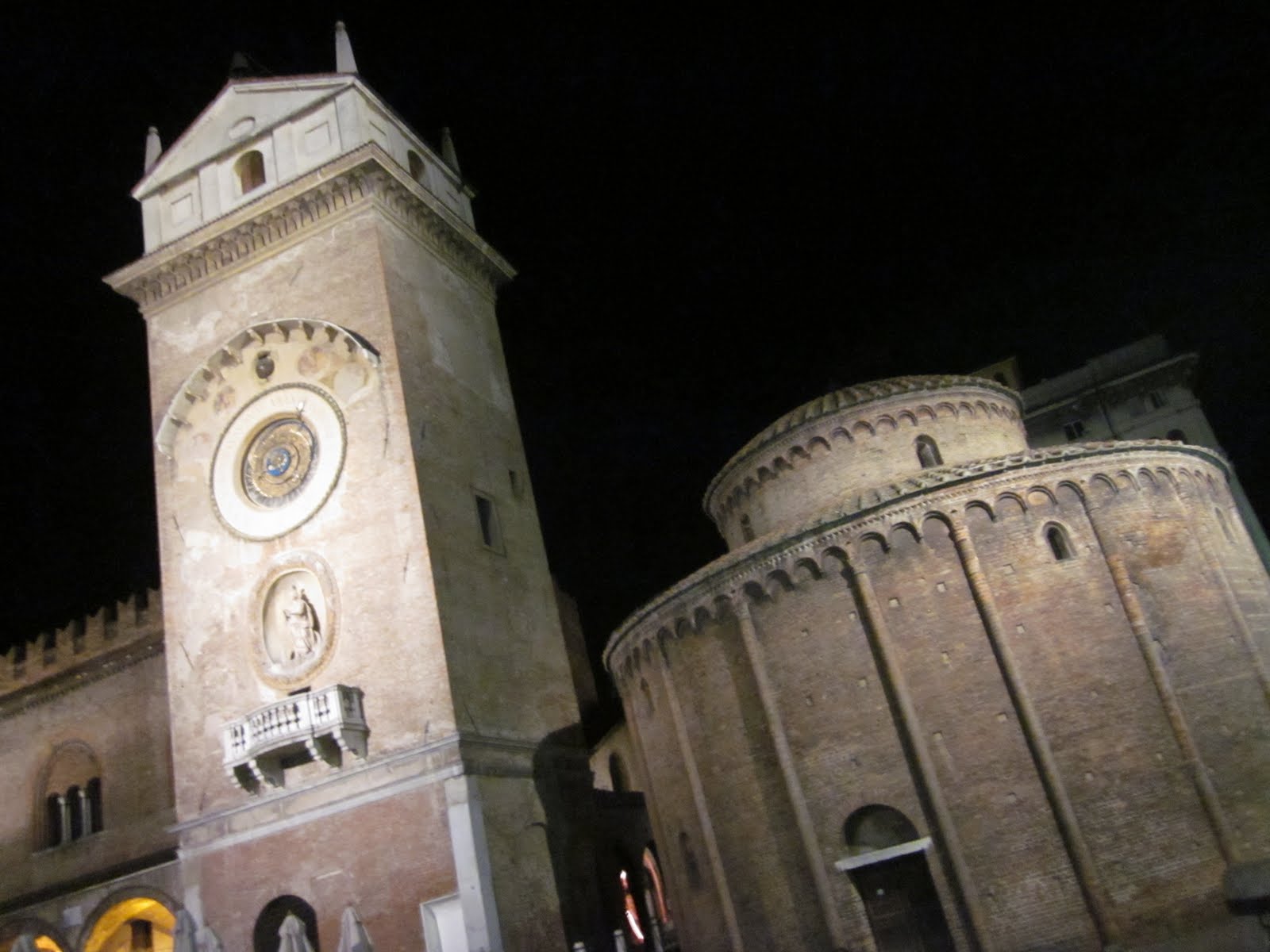
On the way into town we had taken what seemed, according to the map, the best route from the train station; but it was visually uninteresting, and a little isolated. On the way back to the station we cut through the center of town, which was much more lively and attractive (and felt quite safe), even at 10pm. Just past the restaurant we spotted this gorgeous building:


The nighttime photos don’t do it justice, and because it was late and we had to catch a train there was no chance to stop and investigate. But this is the most marvelous thing about Italy: there is something wonderful to look at almost everywhere you turn. You’ll never get to see all of it; if you’re lucky you’ll find something out about a fraction of the artworks in this aesthetically splendid country. These architectural grand-dames confront you literally around every corner, looming, challenging, but also strangely comforting, reminding you that there is sometimes permanency in worldly beauty.

Tuesday, August 31, 2010

When in the former Roman Empire...

…cook some classic Roman dishes for a visitor on her first trip to Italy.

One of my good friends from college (whom we’ll call "Darlingtonia" after the botanical name of one of her favorite flowers) arrived in town yesterday and the occasion called for a fabulous meal. Darlingtonia is spending her last weeks before starting grad school on a grand Mediterranean tour, in which food tourism is as strong a motivating factor as sightseeing. She won’t have time to travel as far south as Rome on this trip, so instead, I brought Rome to Verona—fittingly, given the city's longstanding nickname of “Little Rome.”

We started with an antipasto that was not particularly Roman, but was particularly good: local melon with prosciutto di Parma, and a glass of Prosecco (which, as you may already know, is produced here in the Veneto). Simple, delicious, and very refreshing in this unbearable summer humidity:

Here’s the little neighborhood shop where I’ve been buying my salumi; we went there for the prosciutto.


Every time I go in I have to exercise extreme self-restraint not to buy some of everything in the store.


Pig is beautiful.


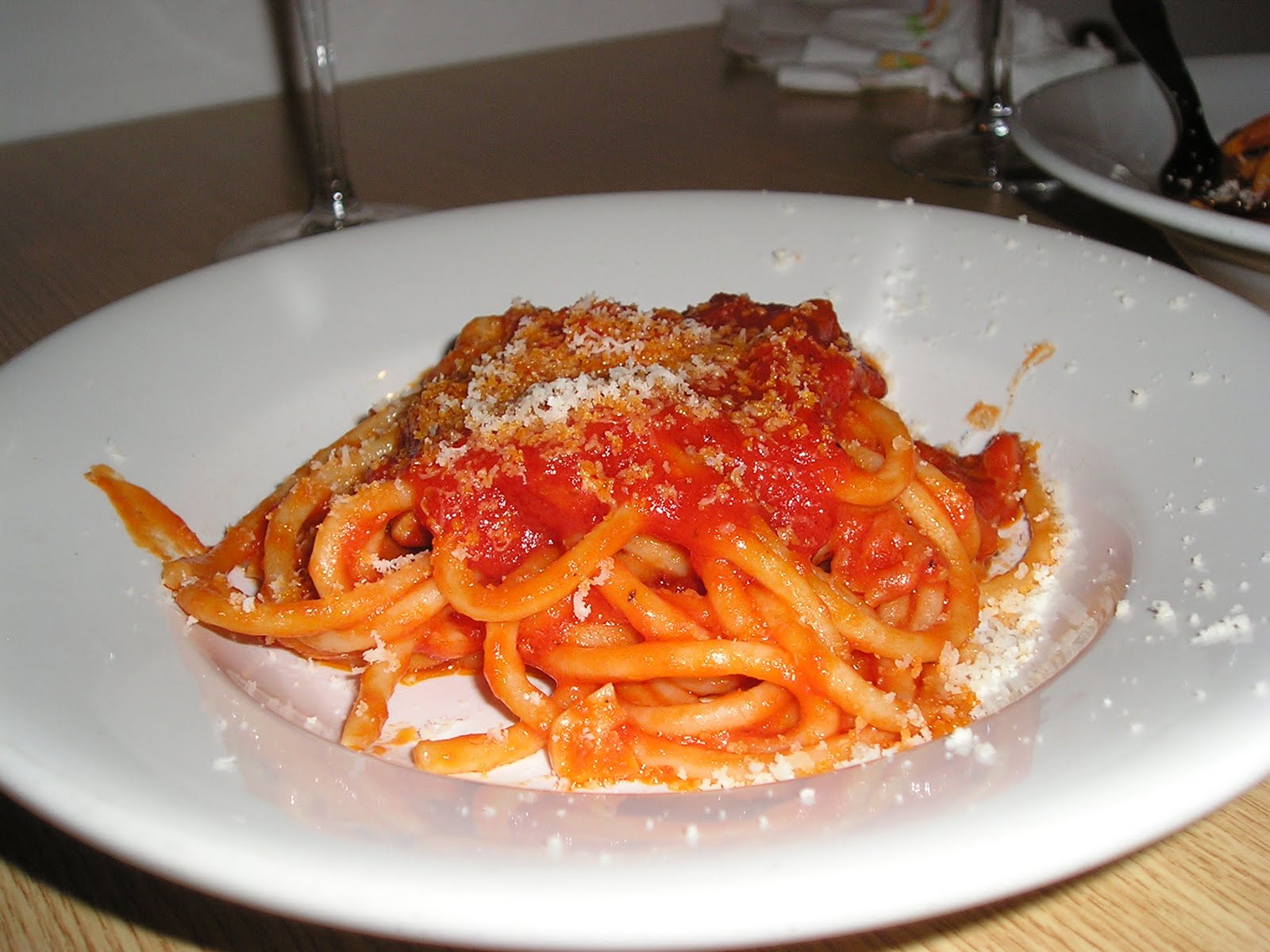
For the primo (pasta course), we had the long-awaited bucatini all’amatriciana. I had forgotten to pick up some hot pepper, so it wasn’t perfect, but it was still good. I made up for the absence of pepper with plenty of garlic, sautéed with the guanciale:


Then add tomato purée, a little black pepper, and toss it with the bucatini. A little cheese on top, naturally (traditionally Pecorino Romano, but Parmesan was what I had on hand):


The secondo (meat course) was another Roman classic, saltimbocca. The name translates roughly to “jump in your mouth”—it’s made from ingredients that, taken individually, are rather delicate, but collude in a finished dish that is quite robust.

Take very thin veal cutlets and layer them with sage and a slice of prosciutto:


For some reason, I remembered that saltimbocca included cheese (mozzarella), so I put some in, but now that I'm doing a little research online, it seems that this is not correct. I know I've eaten them with cheese before--maybe it's an Americanism.


roll them up and send them to the frying pan:


when they are done, eat them with relish.


A complete traditional meal would have included contorni (side dishes) of green vegetables and/or potatoes, but the dishes were already rich enough, so we just had a green salad.

Many thanks to Darlingtonia for sharing her pictures--some were taken with my camera, some with hers, but on the whole hers are much better. (My digital camera is seven years old, which to me seemed perfectly serviceable--I'm not really into technology--but I didn't realize it would be quite such a creaky antique when compared to the newer models. It offers a fraction of the megapixels of the newer models, eats AA batteries like there's no tomorrow, and my biggest memory card holds "only" 80 photos. Clearly I need to go shopping for a new camera when I get home!)

Coming soon: An excursion to a Renaissance palace; food tourism; and opera!
Later: A day in the life of a foreign language student; art history field trip; Venice!!!

Tuesday, August 24, 2010

L'arte di mangiar bene

One of the hardest things about traveling is settling into an eating routine. When I’m jet-lagged I never feel that I want meals at the appropriate mealtimes. The first night in, I had a sandwich at 8:30PM (dinner in Italy, brunch in California), but woke up hungry at 3AM because now it was dinnertime back home. There was, of course, no food in the kitchen when I arrived. By the time I had met with the landlady to get the keys etc, and called home to let everyone know I’d arrived safely, it was after 8PM and the cafés were already starting to close (it was a Sunday). At the only one still open I ordered a panino of roast eggplant, Brie, and speck. It totally hit the spot after a long and tiring trip.

Breakfast was espresso—thank goodness, there was coffee and sugar in the kitchen!—and one of the granola bars I’d brought along as an alternative to airplane food. Which, believe me, was necessary. You’d think you’d be safe ordering the vegetarian meal, right? It should be next to impossible to screw up pasta with tomato sauce, right? So, so wrong. I got a tray of lukewarm penne with a texture reminiscent of dried glue, floating in a watery, sugary pink liquid that bore as little resemblance to real tomatoes as Astroturf to an Alpine meadow. Horrifying. I hadn’t had airplane food in so long I’d forgotten how bad it could be. On the other hand, Air Dolomiti served a rather delightful snack on the short hop to Verona, a mound of sweetened whipped cream topped with raspberry sauce. You read that right: a bowl of whipped cream for each passenger. I only ate a few bites; it was really too rich, but I liked the idea of it.


After school I wandered into the Piazza delle Erbe, squeezing my way past the crowd of tourists gathered around “Juliet’s Balcony.” There were vendors selling every kind of trinket from kids’ T-shirts and souvenir pencils to Pinocchio figurines and elaborately decorated Venetian carnival masks. And, as the name suggests, there’s also a small fruit and vegetable market. Here’s what I picked up:


I have a deep fondness for zucchini blossoms. I haven’t cooked any yet this summer so I was delighted to find them. And the prices were reasonable—all of this was around 3 euro. And for 22 cents I bought a gorgeous nectarine that I snacked on as I walked home. Then it occurred to me that I don’t actually know how to say “nectarine” in Italian.

After coffee break, the rest of today’s language class was spent talking about food. The teacher went around the room and asked each of us to describe a formal meal, e.g. Christmas dinner, in our homeland. Of course, my family doesn’t really do traditional American food for Christmas, so instead I talked about Lebanese food. I described a meal that started with many antipasti (i.e. meze), and tried to list the ones that were easiest on my vocabulary: “leaves of the vine with rice and meat inside, and fava beans with garlic and parsley, and little pizzas of cheese and spinach.” Then, for the main course, “chicken with rice, or little pieces of meat roasted” (how on earth do you say “shish kebab” in Italian?). “Is there a traditional dessert?” asked the teacher. “Yes, we make a pudding of flour of rice with cinnamon and there are nuts on top.” I was almost embarrassed at these garbled descriptions—how is it that I can read Dante, but I can’t describe a simple pudding?—but on the other hand, it was the longest utterance I’d been called upon to produce in Italian in about five or six years. And frankly, everyone in the room was still learning the language; I was hardly the worst off.

I am the only American in a class of seven Europeans and one South American. The rest of the conversation was fairly mouth-watering. The German students described a traditional Christmas feast of roast goose or duck or turkey (“Goose?” asked the Brazilian incredulously; “… quack, quack!” responded the German by way of clarification), served with red cabbage and dumplings; the Brazilian enthused about the fresh tropical fruit juices that were always served at the end of a meal; the Dutch described a childhood breakfast treat of chocolate or sugar sprinkles on buttered toast; the Frenchman waxed rhapsodic about cheeses, which, naturally, got all of us talking excitedly about cheeses.

And then we talked about pasta.

We talked about pasta for a good thirty minutes—about dried pasta and fresh pasta, pasta made with eggs or without eggs, noodles and macaroni and stuffed pastas and hollow pastas. We learned that bavette are the same as linguine and that agnolotti is just the Piedmontese name for tortellini. We talked about the teeny pastina that goes in soups, and the difference between minestrone (mixed vegetable soup) and minestra (clear broth with pastina, children’s food). Back in Santa Cruz, I learned a grown-up version of minestra from my fabulous Sicilian landlady. It goes something like this:

Heat a lot of olive oil in a large pot. Like enough to cover the bottom of the pot, and then some. Put in a lot of chopped garlic. No, a lot of chopped garlic! You shouldn’t be able to see the bottom of the pan, that’s how much chopped garlic you need to put in. [Tip: Buy garlic in bulk, and chop it all at once and keep in your fridge packed in jars of olive oil. Then you never have to spend time chopping garlic at the last minute, because when you’re starving that’s the last thing you feel like doing.] When the garlic smells good and is turning golden, add your vegetables. Usually broccoli, but any green vegetable is good—kale, broccoli rabe, fava beans. Whatever you like, whatever’s fresh. In a separate pot heat up chicken broth, it should be boiling, and cook broken-up spaghetti noodles in it. When the noodles are cooked, carefully pour the broth and noodles into the garlic and vegetable pot. Make sure it’s really hot, stir in a couple handfuls of Locatelli cheese, and serve hot with more cheese on top. And pepper.

Our instructor also made sure we knew that there were certain pasta dishes that people make at home, but that you can’t order in a restaurant. She described pasta al burro as one of the ultimate comfort foods. You cook your macaroni, and then you toss it with equal amounts of butter and olive oil, a generous handful of grated Parmesan cheese, and black pepper. Rigatoni is best for this one because it is one of the largest types of macaroni, and the cheese gets inside the pasta tubes and it is extra delicious that way.

After all that pasta talk, I absolutely had to have pasta for dinner tonight. I kept an eye out for grocery stores on my walk home from school but didn’t see any. The school guide lists a couple of supermarkets near our campus but I didn’t get a chance to look up directions to any—that’ll be later this week, I guess. Instead, after the fruit and vegetable market, I wandered into the salumeria-formaggeria across the street from my apartment, thinking that they surely must have something I could throw together for dinner. I grabbed a bottle of nice olive oil and some excellent prosciutto cotto for sandwiches. As for pasta, well, they only had one line of fancy artisanal pastas for €3,50 per package. I recognized the brand, which is sold in fancy grocery stores at home. In what universe does a pound of dried pasta cost more than that lovely assortment of market vegetables? I decided to splurge anyway, because a) I’ve eaten it and I know it’s good, b) €3,50 is still better than $6.99, and c) I was not about to go wandering the streets in search of a better deal. I was thinking about bucatini all’ amatriciana since it had come up in class, but I balked at the price of the fancy jarred tomato sauce, which anyway seemed like a silly purchase at the height of tomato season. So I went home sans tomato sauce, but with bucatini (basically, spaghetti with a hole in the middle) and guanciale (a key ingredient in the amatriciana—kind of like bacon, only a million times better, and made from the jowls of the pig); a small wedge of Parmesan; and a sampling of gioncata (fresh cheese) because the woman in front of me bought some and it looked delicious. And two little bread rolls. And then I realized I couldn’t make an amatriciana anyway because I didn’t have access to a recipe, and it’s not a dish I know well enough to recreate without guidance.

So instead I threw together a green salad and a pasta dish that I’m calling bucatini imprevisti:

While the water for the pasta is boiling, crisp up a few slices of guanciale. (The guy at the salumeria sliced it paper-thin, and it practically melted on contact with the hot pan. Beautiful.) When crisp, set aside on a small plate to keep warm; cut the zucchini blossoms off the zucchini and place them whole in the pan. Cook a few minutes on each side until crisp. Set blossoms aside with the guanciale, add a little olive oil to the pan, and toss in the zucchini, sliced into thin rounds. By now your water should have boiled; make sure it is well salted and add the pasta. When the zucchini is browned, add about half a cup of the pasta water and reduce until thick. When the bucatini are cooked al dente, drain them, and return to the pot; drizzle in a little more olive oil so they don’t stick. Then add the zucchini and liquid, a generous sprinkling of grated Parmesan, and some ground black pepper. Toss well. Crumble in the crisped guanciale and toss again. Transfer to a warm plate; top with the zucchini blossoms and a little more Parmesan. Buon appetito!