One of the hardest things about traveling is settling into an eating routine. When I’m jet-lagged I never feel that I want meals at the appropriate mealtimes. The first night in, I had a sandwich at 8:30PM (dinner in Italy, brunch in California), but woke up hungry at 3AM because now it was dinnertime back home. There was, of course, no food in the kitchen when I arrived. By the time I had met with the landlady to get the keys etc, and called home to let everyone know I’d arrived safely, it was after 8PM and the cafés were already starting to close (it was a Sunday). At the only one still open I ordered a
panino of roast eggplant, Brie, and speck. It totally hit the spot after a long and tiring trip.
Breakfast was espresso—thank goodness, there was coffee and sugar in the kitchen!—and one of the granola bars I’d brought along as an alternative to airplane food. Which, believe me, was necessary. You’d think you’d be safe ordering the vegetarian meal, right? It should be next to impossible to screw up pasta with tomato sauce, right? So, so wrong. I got a tray of lukewarm penne with a texture reminiscent of dried glue, floating in a watery, sugary pink liquid that bore as little resemblance to real tomatoes as Astroturf to an Alpine meadow. Horrifying. I hadn’t had airplane food in so long I’d forgotten how bad it could be. On the other hand, Air Dolomiti served a rather delightful snack on the short hop to Verona, a mound of sweetened whipped cream topped with raspberry sauce. You read that right: a bowl of whipped cream for each passenger. I only ate a few bites; it was really too rich, but I liked the idea of it.

After school I wandered into the Piazza delle Erbe, squeezing my way past the crowd of tourists gathered around “Juliet’s Balcony.” There were vendors selling every kind of trinket from kids’ T-shirts and souvenir pencils to Pinocchio figurines and elaborately decorated Venetian carnival masks. And, as the name suggests, there’s also a small fruit and vegetable market. Here’s what I picked up:

I have a deep fondness for zucchini blossoms. I haven’t cooked any yet this summer so I was delighted to find them. And the prices were reasonable—all of this was around 3 euro. And for 22 cents I bought a gorgeous nectarine that I snacked on as I walked home. Then it occurred to me that I don’t actually know how to say “nectarine” in Italian.
After coffee break, the rest of today’s language class was spent talking about food. The teacher went around the room and asked each of us to describe a formal meal, e.g. Christmas dinner, in our homeland. Of course, my family doesn’t really do traditional American food for Christmas, so instead I talked about Lebanese food. I described a meal that started with many
antipasti (i.e. meze), and tried to list the ones that were easiest on my vocabulary: “leaves of the vine with rice and meat inside, and fava beans with garlic and parsley, and little pizzas of cheese and spinach.” Then, for the main course, “chicken with rice, or little pieces of meat roasted” (how on earth do you say “shish kebab” in Italian?). “Is there a traditional dessert?” asked the teacher. “Yes, we make a pudding of flour of rice with cinnamon and there are nuts on top.” I was almost embarrassed at these garbled descriptions—how is it that I can read Dante, but I can’t describe a simple pudding?—but on the other hand, it was the longest utterance I’d been called upon to produce in Italian in about five or six years. And frankly, everyone in the room was still learning the language; I was hardly the worst off.
I am the only American in a class of seven Europeans and one South American. The rest of the conversation was fairly mouth-watering. The German students described a traditional Christmas feast of roast goose or duck or turkey (“Goose?” asked the Brazilian incredulously; “
Sì… quack, quack!” responded the German by way of clarification), served with red cabbage and dumplings; the Brazilian enthused about the fresh tropical fruit juices that were always served at the end of a meal; the Dutch described a childhood breakfast treat of chocolate or sugar sprinkles on buttered toast; the Frenchman waxed rhapsodic about cheeses, which, naturally, got all of us talking excitedly about cheeses.
And then we talked about pasta.
We talked about pasta for a good thirty minutes—about dried pasta and fresh pasta, pasta made with eggs or without eggs, noodles and macaroni and stuffed pastas and hollow pastas. We learned that
bavette are the same as
linguine and that
agnolotti is just the Piedmontese name for
tortellini. We talked about the teeny
pastina that goes in soups, and the difference between
minestrone (mixed vegetable soup) and
minestra (clear broth with
pastina, children’s food). Back in Santa Cruz, I learned a grown-up version of
minestra from my fabulous Sicilian landlady. It goes something like this:
Heat a lot of olive oil in a large pot. Like enough to cover the bottom of the pot, and then some. Put in a lot of chopped garlic. No, a lot of chopped garlic! You shouldn’t be able to see the bottom of the pan, that’s how much chopped garlic you need to put in. [Tip: Buy garlic in bulk, and chop it all at once and keep in your fridge packed in jars of olive oil. Then you never have to spend time chopping garlic at the last minute, because when you’re starving that’s the last thing you feel like doing.] When the garlic smells good and is turning golden, add your vegetables. Usually broccoli, but any green vegetable is good—kale, broccoli rabe, fava beans. Whatever you like, whatever’s fresh. In a separate pot heat up chicken broth, it should be boiling, and cook broken-up spaghetti noodles in it. When the noodles are cooked, carefully pour the broth and noodles into the garlic and vegetable pot. Make sure it’s really hot, stir in a couple handfuls of Locatelli cheese, and serve hot with more cheese on top. And pepper.Our instructor also made sure we knew that there were certain pasta dishes that people make at home, but that you can’t order in a restaurant. She described
pasta al burro as one of the ultimate comfort foods. You cook your macaroni, and then you toss it with equal amounts of butter and olive oil, a generous handful of grated Parmesan cheese, and black pepper. Rigatoni is best for this one because it is one of the largest types of macaroni, and the cheese gets inside the pasta tubes and it is extra delicious that way.
After all that pasta talk, I absolutely had to have pasta for dinner tonight. I kept an eye out for grocery stores on my walk home from school but didn’t see any. The school guide lists a couple of supermarkets near our campus but I didn’t get a chance to look up directions to any—that’ll be later this week, I guess. Instead, after the fruit and vegetable market, I wandered into the
salumeria-formaggeria across the street from my apartment, thinking that they surely must have something I could throw together for dinner. I grabbed a bottle of nice olive oil and some excellent
prosciutto cotto for sandwiches. As for pasta, well, they only had one line of fancy artisanal pastas for €3,50 per package. I recognized the brand, which is sold in fancy grocery stores at home. In what universe does a pound of dried pasta cost more than that lovely assortment of market vegetables? I decided to splurge anyway, because a) I’ve eaten it and I know it’s good, b) €3,50 is still better than $6.99, and c) I was not about to go wandering the streets in search of a better deal. I was thinking about
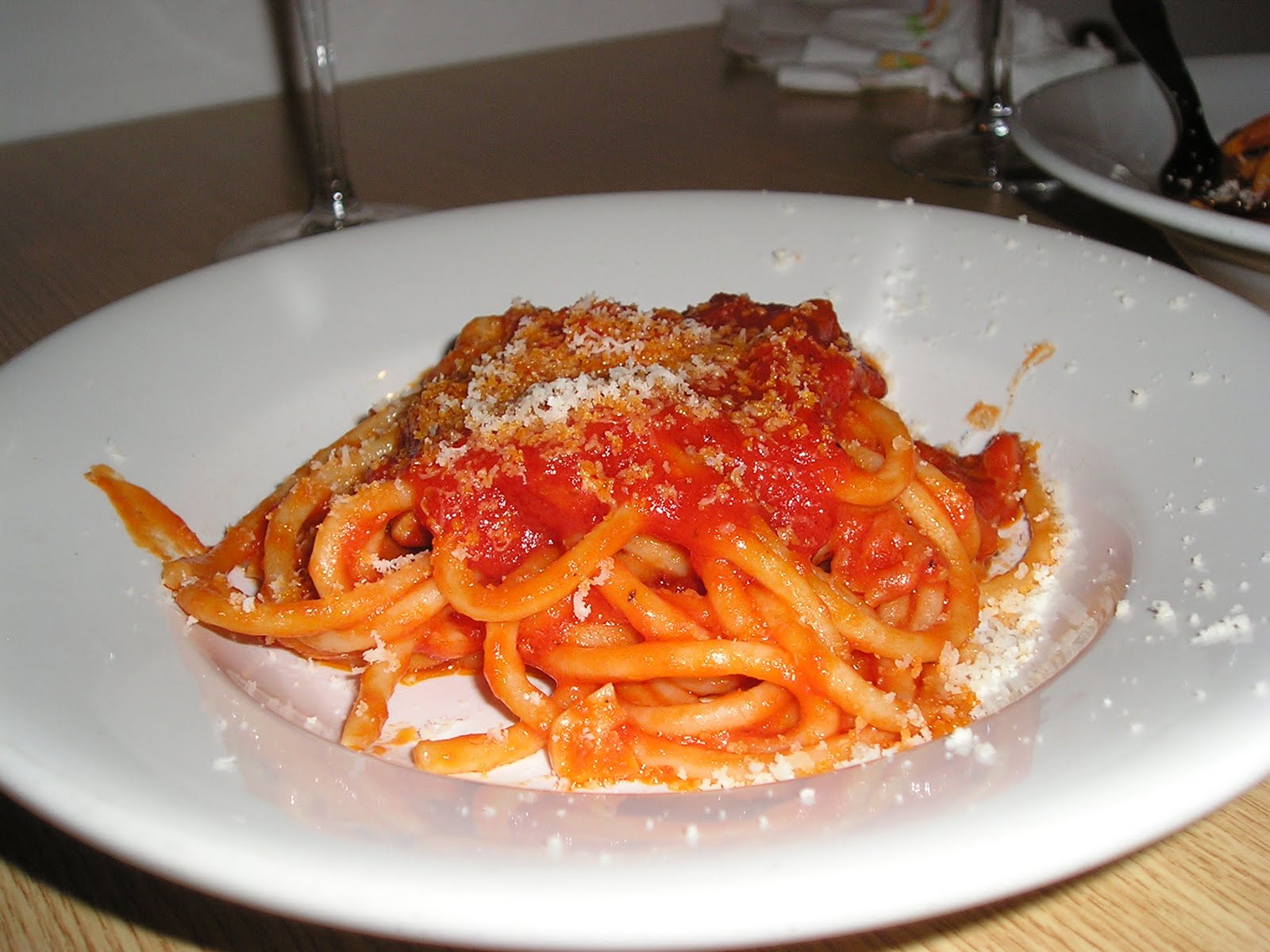
bucatini all’ amatriciana since it had come up in class, but I balked at the price of the fancy jarred tomato sauce, which anyway seemed like a silly purchase at the height of tomato season. So I went home sans tomato sauce, but with bucatini (basically, spaghetti with a hole in the middle) and
guanciale (a key ingredient in the amatriciana—kind of like bacon, only a million times better, and made from the jowls of the pig); a small wedge of Parmesan; and a sampling of
gioncata (fresh cheese) because the woman in front of me bought some and it looked delicious. And two little bread rolls. And then I realized I couldn’t make an amatriciana anyway because I didn’t have access to a recipe, and it’s not a dish I know well enough to recreate without guidance.
So instead I threw together a green salad and a pasta dish that I’m calling
bucatini imprevisti:
While the water for the pasta is boiling, crisp up a few slices of guanciale. (The guy at the salumeria sliced it paper-thin, and it practically melted on contact with the hot pan. Beautiful.) When crisp, set aside on a small plate to keep warm; cut the zucchini blossoms off the zucchini and place them whole in the pan. Cook a few minutes on each side until crisp. Set blossoms aside with the guanciale, add a little olive oil to the pan, and toss in the zucchini, sliced into thin rounds. By now your water should have boiled; make sure it is well salted and add the pasta. When the zucchini is browned, add about half a cup of the pasta water and reduce until thick. When the bucatini are cooked
al dente, drain them, and return to the pot; drizzle in a little more olive oil so they don’t stick. Then add the zucchini and liquid, a generous sprinkling of grated Parmesan, and some ground black pepper. Toss well. Crumble in the crisped guanciale and toss again. Transfer to a warm plate; top with the zucchini blossoms and a little more Parmesan.
Buon appetito!