Showing posts with label classics. Show all posts

Thursday, September 9, 2010

San Zeno

Io fui abate in San Zeno a Verona
sotto lo 'mperio del buon Barbarossa...
I was abbot of San Zeno in Verona,
under the governance of the good Barbarossa...
--Dante Alighieri, Purgatorio XVIII.118-9

Today’s history tour took place in the eye of a storm. Last night it started raining; this morning, it rained; we had a brief respite in the afternoon, a couple hours of glorious hot sunshine, and then almost as soon as it got dark the rain recommenced, this time with lightning and window-rattling thunder. My apartment has a skylight, which is lovely, but now is letting in both noise and light, which is not exactly conducive to getting much sleep. Not that I’m complaining!

Today the fabulous A. led us to the basilica of San Zeno, which is the most beautiful thing I’ve seen in Verona so far. The original monument to San Zeno was built in the fourth century, shortly after his death; construction of the three-level structure that is the current basilica began in the 10th century, was destroyed by invaders and earthquakes, and was finally completed around 1380. The basilica was built on the site of the old Roman cemetery, in honor of the city’s patron saint, and has been remarkably well preserved. After the Scala family lost political control and Verona came under the power of the Republic of Venice, it also took control of San Zeno; the abbots of the basilica's monastery were all appointed by the Doge, but they lived most of the year in Venice, which meant they pretty much left the church grounds alone. On the one hand, this preserved all the artwork, including the extraordinary frescoes adorning nearly every wall; on the other hand, this meant the buildings were not well maintained, and the monastery itself collapsed in the early 19th century (I think! just for the record, I don't take notes during these tours :-). The church grounds, which are extremely large, represent only one-third the area of the medieval complex.

I don’t know whether the fault lies with my camera, which doesn’t seem to like to focus from a distance of more than a few feet, or with my own self because I’m a lousy photographer, but unfortunately many of the pictures I tried to take came out blurry, so I have fewer to share than I would like. But here are a handful:


As you can see, the church is covered with scaffolding because it’s under restoration, so I didn’t take any other exterior pictures. Inside, though:

Here’s San Zeno, who was the first Bishop of Verona. You can also see him in the detail of the portico, above. He is, naturally, always depicted with mitre and scepter, because of his status as bishop; he is depicted making a sign of blessing (three fingers extended) because he converted the Veronese to Christianity; and he is depicted with dark skin because he was thought to be African. Legend has it he was born in Mauritania, though A. points out that modern scholars think he was probably European. But because he wrote about other African saints, it was thought that Zeno was African as well. And, finally, he is depicted with a fish hanging from his scepter as if from a fishing-pole. His great friend St. Ambrose, the Bishop of Milan--the mentor of yet another African saint, Augustine--described Zeno as "a fisherman of souls," and so he is represented in iconography with a fish.


This is the tomb of Giuseppe della Scala (remember those Scala guys? come il prezzemolo), onetime abbot at San Zeno--late thirteenth century.


He won a spot in Dante's Divine Comedy, though not a favorable one (he appears in Purgatorio); he was criticized for taking the position in the church not out of religious faith, but in order to further his family's political agenda. Even if one questions his piety, there's no doubt that he was materially beneficial; for example, he paid for the restoration of the cloister:


If you look very closely, you may be able to see that there are two architectural styles visible. The arches in the center are rounded (Romanesque) while the ones in the shady area on the left are pointed (Gothic). The Gothic arches are the more recent ones, and were part of Giuseppe della Scala's renovation project.

And speaking of architecture, here's another nifty thing I learned on the tour. Notice the red-and-white stripes along the outside of the building? You see this everywhere in Italian Gothic architecture, especially churches, I think. It's very beautiful. But it was not done merely for aesthetics. The alternation of terracotta bricks with marble blocks was actually a technique for strengthening a building against damage from earthquakes. If you look closely at the photo below, you'll see that, in fact, the stripes do not line up perfectly--proof that it wasn't just for looks!


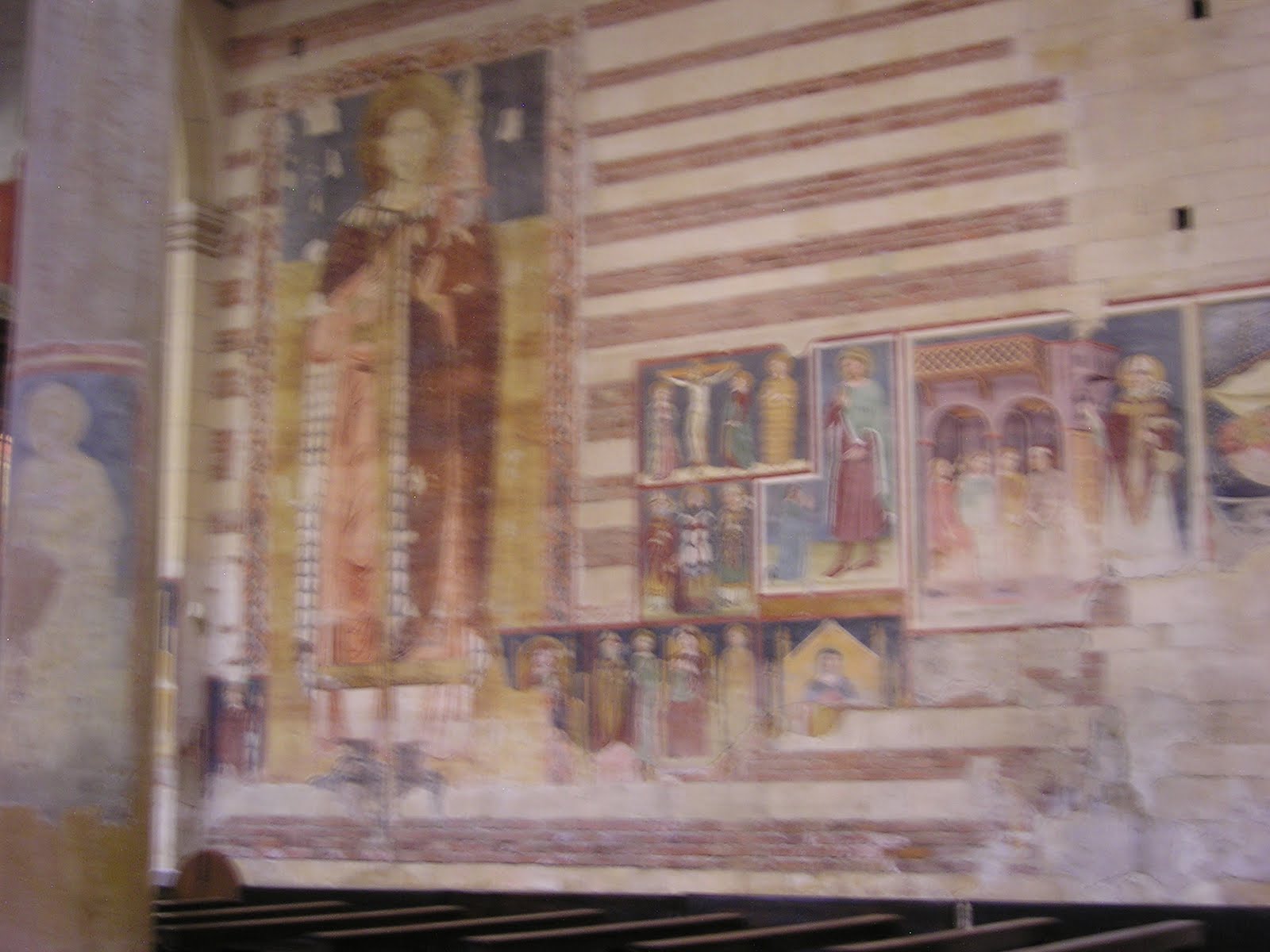
Both the outer walls of the cloister and the inner walls of the church are lavishly decorated with frescoes. I'm heartbroken that more of these came out blurry, but I hope they convey some sense of the visual richness of this place:


More famous than the frescoes, though, is the immense 15th-century painting by Andrea Mantegna that stands before the altar.


It has always been described as a tryptich, because it is divided into three panels, but art historians point out that it is mislabeled. In a triptych, each panel is a separate image with its own vanishing point. In this Mantegna piece, the three panels are part of the same larger image and share a single vanishing point in the central panel. But this piece has been known as "the triptych" for so long that it's hard to break the habit.

This photo does not even come close to doing it justice, but rest assured, it is splendid: vivid, detailed, expressive. The festoon at the top is a funeral decoration; although Mary is holding the infant Christ and surrounded by important saints, she has a look of melancholy. She is standing on a red carpet, but underneath that is depicted Christ's tomb. In this painting she is called Madonna vittoriosa sopra la morte, the Madonna victorious over death. For the moment, at least. She knows the Sacrifice is coming.

I won't talk about the fact that the painting was damaged when Napoleon ran off with it, nor that the three small panels at the bottom are quick copies because the originals have been in the Louvre since the nineteenth century... you'd think they would be willing to put them back in their original place rather than having the artwork piecemeal all over Europe.


The basilica is also famous for its enormous twelfth-century doors, each covered in 24 meticulously worked bronze plaques:


Each of the doors has a plaque of a single face with an open mouth; this, instead of a doorknob, was where you gripped the door to open or close it.


There is a series of four plaques representing the miracles of San Zeno. In the top right, he's exorcising a demon that has possessed a young girl; in the bottom left, he's saving a man from falling into the Adige River when his oxen (also, apparently, possessed) ran off with his cart.


The Last Supper (Judas is below the table, as if he could drop into Hell at any moment):

I'm pretty sure this one is Salome with the head of John the Baptist:


I got a huge kick out of the detail of the dinner table. Knife, cup, bread--very civilized, apart from that floating head!

And finally, one of the last things I saw as I was walking out of the church was this fantastic, immense manuscript:


It was unlabeled, and I won't embarrass myself by hazarding a guess at the date (I am not a paleographer). However, I did totally impress one of my monk-classmates (yes, "one of"--there are a few!) by reading the Greek aloud and identifying the text (John 1:1, for those of you playing along at home: "In the beginning there was the Word..." Thank you, Latin Carol Celebration, for drilling this passage into my memory!).

When I came home for dinner I was feeling too lazy to cook, and I’d had pasta e fagioli three nights in a row, so I threw together this salad, another Veneto classic:


It’s arugula, bresaola (air-dried beef), and shavings of grana padano cheese (the local answer to Parmesan). Light and fresh, but pretty filling because of the meat and cheese. In the US a version of this is served as “beef carpaccio,” but the original carpaccio, it seems, doesn’t have arugula in it; this dish is traditional for bresaola, not raw beef. (The “real” beef carpaccio, created at Harry’s Bar in Venice ca. 1950, is simply thin slices of beef with a mayonnaise-based dressing. It was named for the Renaissance painter Vittore Carpaccio [1460-1526], supposedly in homage to the vivid reds he used in his paintings.) But the combination of crisp, bitter greens and richly flavored beef is so seductive; almost every time I make myself a little steak at home, I plate it next to, or even on top of, a pile of arugula or occasionally watercress. The greens wilt a little from the heat and soak up the meaty juices, while still balancing the richness of the beef with their pungent herbaceousness. I love this combination so much that I will even order it in restaurants, breaking my personal rule of not ordering what I could easily make in my own kitchen. Earlier this summer I had a version of it at Nostrana in Portland, which does classic Northern Italian food with Pacific Northwest ingredients (in this case, local grass-fed beef). The chef drizzled the steak with a sharp garlic-rosemary-olive oil dressing. Simple enough to make at home, but so delicious and carefully prepared that it was totally worth restaurant prices.

Tuesday, September 7, 2010

Mangiafagioli

“What I love about cooking is that after a hard day, there is something comforting about the fact that if you melt butter and add flour and then hot stock, it will get thick! It’s a sure thing! It’s a sure thing in a world where nothing is sure…”
--Nora Ephron, Heartburn

I went to Venice last weekend. It was… I don’t have words. Or rather, I have too many words, and it’s going to take me some time to figure out which ones I want to use, so I’m afraid those of you reading this will have to be patient in waiting for the post(s) on La Serenissima. But it was amazing.

I left in a hurry on Friday, after school and a thoroughly delightful but longer-than-planned farewell lunch for a classmate. (Note to self: aperitivo + gnocchi + hot afternoon sunshine on Piazza Brà = a sluggish Buongustaia.) Starting with the mad dash from my apartment to the Verona train station, and ending with the mad dash through inscrutable Venetian alleyways to catch the last train home, the weekend was a nonstop blur of activity. I will spare you the lamentations for my poor, achy, blistered little feet, because the weekend was worth every blister! I had school Monday morning, of course, and after class, I was still groggy and sore. No energy to go out about town, and besides, I had things to do at home. The day was cool and overcast—almost no sunshine. Best way to fight the cloudy-day blues and post-travel fatigue? Cook!

One of my favorite cool-weather comfort foods is pasta e fagioli—pasta and beans. It’s warm and nourishing and soothing, like all the best soups, but it’s not quite a soup. When I had it in Rome it was beans and noodles and vegetables in a clear broth, soup-like, but in Northern Italy it’s more like a porridge, with the beans mashed, or simply cooked to the point of dissolution, to thicken the broth. In fact, the more I see of this dish in the North—both Tuscany and the Veneto claim it as their own—the more I think that the Roman version was gussied up for restaurant service, and not at all a typical preparation. But it was still delicious.

Borlotti are the beans traditionally used for this dish; in the US, cranberry beans make a fine substitute (they are similarly colored, white with rosy mottling). Pinto beans work in a pinch—I like them better than either cannellini or kidney beans, for color and texture—or you can use chickpeas and call it pasta e ceci. I actually already had a can of borlotti beans in the cupboard, thinking that, as the weather turned cooler, I might want to make this. But when I went to the vegetable market, they had fresh borlotti, and since they are in season, how could I pass them up?

I hadn’t been to the vegetable stalls in several days, since I needed to use up the produce I already had before leaving to Venice. It was, as always, fun and informative. I started with the carrots. The vendor bustled over and swatted my hands away. I was surprised, because normally customers are allowed to select their own vegetables. But she said, “Wait a minute—these carrots are no good. Let me get them out of the way for you.” She picked through the bin and selected half a dozen cracked or limp carrots, which she then laid to the side, and said, “There you go. Those others were ugly. These are beautiful. Go on, pick the ones you want.” So I did. And then I reached toward the celery: sturdy bunches with full heads of thick, dark green leaves. “You’re making a broth?” asked the vendor. I nodded, and she snapped two crisp stalks off at the root end and put them in the bag with the carrots. (This is totally brilliant, because while I like celery I don’t use it in that many things, and when I have to buy a whole bundle invariably it goes bad before I can use it all. Buying by the stalk is really ideal. Why don’t American grocers let you do that?) Next, “You need some onion.” This was not a question. “Red, white? How many?” “One white, please.” Garlic, or anything else? No, I had all that at home.


Pasta e fagioli is very easy to make, although it can be time-consuming. I usually make one of three versions: very slow, very fast, or not-too-slow.

The very slow version simply means that I start with dried beans and soak them and boil them. It takes hours, but then you get a bean broth, and it’s much tastier than canned beans. If I’m in a SlowFood mood, I also use homemade broth and (as I had it in Rome) scraps of fresh pasta dough instead of dried noodles.

The very fast version goes like this: Heat up some broth (chicken or veg, depending on your persuasion). Boil pasta in it. Whatever kind of pasta you have on hand. Smaller, shorter is better. If all you have is spaghetti or other noodles, just break them into little bits. When the pasta is cooked, add canned beans that have been rinsed and drained. Simmer a couple minutes until it’s all heated through, then season with salt and pepper, serve with a little olive oil and parmesan on top. It's a pale imitation of the real thing, but it’s still very tasty, and a great quick supper—takes barely 15 minutes, and I nearly always have the ingredients on hand.

The not-so-fast version makes a concession to the use of canned beans, and takes a little more patience than the fast-food version, but is more delicious and satisfying:

Start with a soffritto of onion, carrot, celery, and a couple cloves of garlic. There should also be herbs; at home I might use thyme, oregano and/or bay leaf, but since I didn't have any of that on hand I just used the celery leaves.


I need to take a moment here to say a few words about celery leaves. We’ve all had them in our kitchens, pretty much, because when we buy a bunch of celery it usually comes with the leaves. And most of us throw them away! Please, dear readers, do not neglect your celery leaves. They are fresh and herbaceous and aromatic and delicious. You can put them in salads (example: thin slivers of celery stalk, shavings of Parmesan, chopped celery leaves and parsley, dress with lemon juice and olive oil), or you can chop them up and throw them in with your soffritto or mirepoix or whatever cooking base you use. I always put celery leaves in my stocks. You can use it like any other herb in dressings, sauces, or even soft cheeses and compound butters. For example, there is a poem attributed to Vergil that describes a peasant’s lunch of cheese seasoned with garlic, oil, vinegar, salt, coriander, rue and comas apii graciles—celery’s delicate tresses. Delectable.

Anyway, back to our pasta e fagioli. Optional additions to the soffritto: a little tomato paste, a little lardo or guanciale, or, if you’re daring, a pinch of hot red pepper flakes. Add broth or water, bring to a boil. Add the beans (rinsed and drained, if using canned; if using dried beans, add their cooking liquid too). Once the beans are heated through, this is the step where you mash the beans, if you want a thick soup. At home I use an immersion blender and give it a few quick pulses, not enough to purée the whole thing, just to break up about half the beans. La nonna would use an old-fashioned food mill. If you don’t have either of these implements, a potato masher works just fine. Naturally, the immersion blender goes straight in the pot, but if you want to use a mill or masher, take out about half the beans with a slotted spoon, mash them and then add them back in.

If you have enough broth, and depending on how soupy you want the dish you be, you can cook the pasta directly in the pot. I personally prefer to do it this way, as I’m a fan of one-pot meals, especially on busy weeknights. You can also cook the pasta separately, in salted water, and add it already cooked to the pot of beans. (This is also a terrific way to use up leftovers, if you have some plain cooked noodles lying around.) Once everything is cooked through and quite hot, check the seasoning, ladle into bowls, and dress with a drizzle of olive oil, black pepper and Parmesan.


This is the first time I’ve made pasta e fagioli with fresh beans, and they took almost an hour to cook—but still, much faster than dried, and with a creamier texture and subtler flavor. I made a big pot so I’ll be eating it all week, but I don’t expect to get tired of it anytime soon!

Oh, and let's not forget dessert:

Tuesday, August 24, 2010

Iam mens praetrepidans avet vagari...

iam mens praetrepidans auet uagari.
iam laeti studio pedes uigescunt.
o dulces comitum ualete coetus.
longe quos simul a domo profectos
diuersae uarie uiae reportant.
Now my mind shivers with anticipation,
Wishing to wander out into the world—
Now my eager feet are quick to move.
Farewell, my gathering of dearest friends;
Various roads will always lead us back
When we have traveled far from our homes.
--Gaius Valerius Catullus, carmen xlvi

I keep forgetting that Verona is the ancestral home of my favorite poet. Well, one of my favorite poets. My favorite Roman poet, at any rate—not counting Ovid or Vergil. Catullus is perhaps my sentimental favorite, my earliest introduction to Latin poetics, my first foray into poetry translation, my favorite source of salacious witticisms. Catullus may be best known for dirty epigrams, political jabs, and an unceasingly painful love affair with a woman he called Lesbia, but he’s far more sentimental than his reputation usually allows. His poems are populated by bitter jilted lovers, whores and corrupt politicians (one can’t always tell the difference!), but also by chirping sparrows, blushing maidens and laughing, generous friends. The most tender and loving verses, though, are those that evoke a sense of place, describing a homecoming or a departure—even the voyage to his brother’s funeral is infused with sweetness. Trace a geography of the Catullan corpus and you’ll find spokes radiating outward to the Roman provinces, but always returning to Italy, both spatially and emotionally its heart.

I landed at my sentimental favorite Roman poet’s namesake airport Sunday evening, my feet eager and my mind beyond shivery. I’ll be spending the next four weeks in Verona for an intensive language study course, and I expect I’ll be getting to know the city quite well. Already I got better acquainted with it this morning than planned—missed a turn on my way to school and walked almost a kilometer further than needed before I realized I was getting myself lost. On the way back I took the more scenic route, through Piazza Brà and around the Arena. Behind the Arena I spotted a grove of spears and pennants, a Sphinx head and miniature pyramid peeking up from behind makeshift walls: sets for the opera! Clearly the Egyptian bits belong to the Aida production, and I’m guessing the weaponry is from Il Trovatore. This is the last week of the summer season; I hope I’ll be able to see a show before it ends.


I’m subletting a darling apartment on Via Stella, which runs behind the Arena. It’s an old building, but recently renovated and very nice. And extremely secure—I need three keys to get in! It has an elevator and air conditioning, both blessings—but the air is only in the dining room, not the bedroom, and the elevator was barely big enough for me to squeeze into with my small carry-on suitcase and backpack. While crammed in there, I was congratulating myself on not having succumbed to the temptation of bringing a larger suitcase. On the other hand, even this morning I felt like complaining that I had nothing to wear… My apartment consists of a small kitchen/dining room, an amply sized bedroom, and a small, spotless, shiny-new bathroom, with dark wood fixtures against white tiles. The bathtub is absurdly small, though. I’m only 5’2” and yet to take a proper bath I would have to sit with my knees scrunched up to my chin! The kitchen is pretty well equipped—just enough pots and pans, cute mismatched tableware, cheerful linens, and a four-burner gas range. No oven, but I couldn’t stand to use one in this heat anyway. There’s also a TV that I will probably never turn on, and stereo speakers that I might use if I can figure out how to connect them to my iPod.


(this is not supposed to be sideways!)

Two angles of the view from my bedroom window. The first was taken at sunset, the next early the following morning.