Showing posts with label fruit. Show all posts

Friday, September 10, 2010

The Bitter Berry / Il Mirtillo Rosso

“Faced with the challenge of explaining the cornerstone of Christianity, we did what any self-respecting group of people might do. We talked about food instead.”
-- David Sedaris, “Jesus Shaves”

So last night I was sitting in my apartment, eating yet another bowl of pasta e fagioli (what was I thinking, making such a big pot?!), and drinking the last of the Lambrusco I picked up in Mantova. (Man… when I drink Lambrusco here I can’t believe I ever liked the $5 stuff at Trader Joe’s. I mean, yeah, it’s cheap and it’s festive, but it’s so sweet, you can’t really drink it with food. The real Lambrusco is crisp, maybe a little bit sweeter than most reds, but definitely not sweet sweet. But I digress.)

So I’m sitting there having dinner, and I turn on the TV. And what happens to be on? The Simpsons! So I watch an episode of the Simpsons in Italian. One I haven’t seen in English, by the way, so I actually have to pay attention to the dialogue. And I’m pretty pleased that I can follow pretty easily. But…it’s so weird. Surreal, actually, to be watching it in another language. The episode starts with Homer voting in the Obama-McCain election. It proceeds through a parody of the Transformers movie, a parody of Mad Men and a Halloween romp, and ends with a Thanksgiving turkey—in Pilgrim costume, no less—bursting onto the scene. When Bart talks about eating a turkey dinner, the bird retaliates by chasing and gobbling the children.

And I’m sitting there wondering exactly how this reads to Italian kids watching the show. Certainly they are familiar with American pop culture—movies and TV shows and music—and from those they must get some familiarity with American holidays like Halloween and Thanksgiving. By a strange coincidence, our lessons that day had included some discussion of holidays. Ostensibly, it was for us to learn about Italian culture, but of course we all ended up discussing our own traditions.

Yesterday’s class was just me and two of the monks (they, too, are like parsley). (I know it probably seems a little weird that I keep going on about all the monks at my school. It’s just that their presence in my secular-humanist world is such a novelty. Plus all the ones I’ve met so far are pretty cool dudes.) Our teacher asked me to describe Thanksgiving, provided I used its Italian name, il giorno del ringraziamento. When did we celebrate it, she asked? Fourth Thursday in November. And this is the holiday where we eat turkey, right? Yes. And what else? Well, we eat the turkey with a sauce made from…wait a second… I looked up “cranberry” in my dictionary and found mirtillo, which is actually a blueberry. Huh? “The dictionary did not translate it correctly,” I said. “The dictionary says blueberry, but this is not correct. Blueberries are blue and sweet. The fruit we eat at Thanksgiving is red and bitter.” I said it was a type of berry, but this is another thorny bit of vocabulary. In Italian, berries are frutti di bosco, that is, woodland fruits. Cranberries don’t grow in the woods, they grown in a marsh. The teacher asked me if I maybe meant red currants. No, no… The Russian monk tried to help. He had eaten this fruit sauce, he said, when his best friend at his old monastery, an American, had cooked a traditional Thanksgiving dinner for the brothers. How they found cranberries in Vladivostok is a mystery, though.

It was the Ukrainian who finally came to the rescue. In his Italian-Russian dictionary, he found an entry for cranberries: mirtilli della palude, literally, bog blueberries. But even though we now had a name for them, we had only this perplexing description of a woodland fruit that grows in a swamp, is red and bitter, was cooked with sugar until it becomes like gelatin, and then is served with roast turkey. It sounds kind of dreadful, actually, doesn’t it? My mother describes her first American Thanksgiving as utterly perplexing—meat served with a fruit sauce? How bizarre! (Now she loves it, though, and makes the world's best cranberry sauce, in my humble opinion.) The concept is somewhat less foreign to Northern Italians familiar with mostarda, a fruit conserve that is served with boiled meats. In fact, when I first mentioned the cranberry sauce, my teacher said, with an understanding nod, “Like mostarda?” When we talked about Italians eating lentils on New Year’s Day, I had a similarly difficult time explaining the analogous American tradition of eating black-eyed peas (“they are called peas, but they are actually beans, and they are white with a black spot”), because no one knew what those were, beyond the name of the music group.

From traditional food the discussion moved on to traditional drinks, and there, we all understood each other perfectly: beer is good, but wine is better. Nunc est bibendum.

Tuesday, September 7, 2010

Mangiafagioli

“What I love about cooking is that after a hard day, there is something comforting about the fact that if you melt butter and add flour and then hot stock, it will get thick! It’s a sure thing! It’s a sure thing in a world where nothing is sure…”
--Nora Ephron, Heartburn

I went to Venice last weekend. It was… I don’t have words. Or rather, I have too many words, and it’s going to take me some time to figure out which ones I want to use, so I’m afraid those of you reading this will have to be patient in waiting for the post(s) on La Serenissima. But it was amazing.

I left in a hurry on Friday, after school and a thoroughly delightful but longer-than-planned farewell lunch for a classmate. (Note to self: aperitivo + gnocchi + hot afternoon sunshine on Piazza Brà = a sluggish Buongustaia.) Starting with the mad dash from my apartment to the Verona train station, and ending with the mad dash through inscrutable Venetian alleyways to catch the last train home, the weekend was a nonstop blur of activity. I will spare you the lamentations for my poor, achy, blistered little feet, because the weekend was worth every blister! I had school Monday morning, of course, and after class, I was still groggy and sore. No energy to go out about town, and besides, I had things to do at home. The day was cool and overcast—almost no sunshine. Best way to fight the cloudy-day blues and post-travel fatigue? Cook!

One of my favorite cool-weather comfort foods is pasta e fagioli—pasta and beans. It’s warm and nourishing and soothing, like all the best soups, but it’s not quite a soup. When I had it in Rome it was beans and noodles and vegetables in a clear broth, soup-like, but in Northern Italy it’s more like a porridge, with the beans mashed, or simply cooked to the point of dissolution, to thicken the broth. In fact, the more I see of this dish in the North—both Tuscany and the Veneto claim it as their own—the more I think that the Roman version was gussied up for restaurant service, and not at all a typical preparation. But it was still delicious.

Borlotti are the beans traditionally used for this dish; in the US, cranberry beans make a fine substitute (they are similarly colored, white with rosy mottling). Pinto beans work in a pinch—I like them better than either cannellini or kidney beans, for color and texture—or you can use chickpeas and call it pasta e ceci. I actually already had a can of borlotti beans in the cupboard, thinking that, as the weather turned cooler, I might want to make this. But when I went to the vegetable market, they had fresh borlotti, and since they are in season, how could I pass them up?

I hadn’t been to the vegetable stalls in several days, since I needed to use up the produce I already had before leaving to Venice. It was, as always, fun and informative. I started with the carrots. The vendor bustled over and swatted my hands away. I was surprised, because normally customers are allowed to select their own vegetables. But she said, “Wait a minute—these carrots are no good. Let me get them out of the way for you.” She picked through the bin and selected half a dozen cracked or limp carrots, which she then laid to the side, and said, “There you go. Those others were ugly. These are beautiful. Go on, pick the ones you want.” So I did. And then I reached toward the celery: sturdy bunches with full heads of thick, dark green leaves. “You’re making a broth?” asked the vendor. I nodded, and she snapped two crisp stalks off at the root end and put them in the bag with the carrots. (This is totally brilliant, because while I like celery I don’t use it in that many things, and when I have to buy a whole bundle invariably it goes bad before I can use it all. Buying by the stalk is really ideal. Why don’t American grocers let you do that?) Next, “You need some onion.” This was not a question. “Red, white? How many?” “One white, please.” Garlic, or anything else? No, I had all that at home.


Pasta e fagioli is very easy to make, although it can be time-consuming. I usually make one of three versions: very slow, very fast, or not-too-slow.

The very slow version simply means that I start with dried beans and soak them and boil them. It takes hours, but then you get a bean broth, and it’s much tastier than canned beans. If I’m in a SlowFood mood, I also use homemade broth and (as I had it in Rome) scraps of fresh pasta dough instead of dried noodles.

The very fast version goes like this: Heat up some broth (chicken or veg, depending on your persuasion). Boil pasta in it. Whatever kind of pasta you have on hand. Smaller, shorter is better. If all you have is spaghetti or other noodles, just break them into little bits. When the pasta is cooked, add canned beans that have been rinsed and drained. Simmer a couple minutes until it’s all heated through, then season with salt and pepper, serve with a little olive oil and parmesan on top. It's a pale imitation of the real thing, but it’s still very tasty, and a great quick supper—takes barely 15 minutes, and I nearly always have the ingredients on hand.

The not-so-fast version makes a concession to the use of canned beans, and takes a little more patience than the fast-food version, but is more delicious and satisfying:

Start with a soffritto of onion, carrot, celery, and a couple cloves of garlic. There should also be herbs; at home I might use thyme, oregano and/or bay leaf, but since I didn't have any of that on hand I just used the celery leaves.


I need to take a moment here to say a few words about celery leaves. We’ve all had them in our kitchens, pretty much, because when we buy a bunch of celery it usually comes with the leaves. And most of us throw them away! Please, dear readers, do not neglect your celery leaves. They are fresh and herbaceous and aromatic and delicious. You can put them in salads (example: thin slivers of celery stalk, shavings of Parmesan, chopped celery leaves and parsley, dress with lemon juice and olive oil), or you can chop them up and throw them in with your soffritto or mirepoix or whatever cooking base you use. I always put celery leaves in my stocks. You can use it like any other herb in dressings, sauces, or even soft cheeses and compound butters. For example, there is a poem attributed to Vergil that describes a peasant’s lunch of cheese seasoned with garlic, oil, vinegar, salt, coriander, rue and comas apii graciles—celery’s delicate tresses. Delectable.

Anyway, back to our pasta e fagioli. Optional additions to the soffritto: a little tomato paste, a little lardo or guanciale, or, if you’re daring, a pinch of hot red pepper flakes. Add broth or water, bring to a boil. Add the beans (rinsed and drained, if using canned; if using dried beans, add their cooking liquid too). Once the beans are heated through, this is the step where you mash the beans, if you want a thick soup. At home I use an immersion blender and give it a few quick pulses, not enough to purée the whole thing, just to break up about half the beans. La nonna would use an old-fashioned food mill. If you don’t have either of these implements, a potato masher works just fine. Naturally, the immersion blender goes straight in the pot, but if you want to use a mill or masher, take out about half the beans with a slotted spoon, mash them and then add them back in.

If you have enough broth, and depending on how soupy you want the dish you be, you can cook the pasta directly in the pot. I personally prefer to do it this way, as I’m a fan of one-pot meals, especially on busy weeknights. You can also cook the pasta separately, in salted water, and add it already cooked to the pot of beans. (This is also a terrific way to use up leftovers, if you have some plain cooked noodles lying around.) Once everything is cooked through and quite hot, check the seasoning, ladle into bowls, and dress with a drizzle of olive oil, black pepper and Parmesan.


This is the first time I’ve made pasta e fagioli with fresh beans, and they took almost an hour to cook—but still, much faster than dried, and with a creamier texture and subtler flavor. I made a big pot so I’ll be eating it all week, but I don’t expect to get tired of it anytime soon!

Oh, and let's not forget dessert:

Tuesday, August 31, 2010

When in the former Roman Empire...

…cook some classic Roman dishes for a visitor on her first trip to Italy.

One of my good friends from college (whom we’ll call "Darlingtonia" after the botanical name of one of her favorite flowers) arrived in town yesterday and the occasion called for a fabulous meal. Darlingtonia is spending her last weeks before starting grad school on a grand Mediterranean tour, in which food tourism is as strong a motivating factor as sightseeing. She won’t have time to travel as far south as Rome on this trip, so instead, I brought Rome to Verona—fittingly, given the city's longstanding nickname of “Little Rome.”

We started with an antipasto that was not particularly Roman, but was particularly good: local melon with prosciutto di Parma, and a glass of Prosecco (which, as you may already know, is produced here in the Veneto). Simple, delicious, and very refreshing in this unbearable summer humidity:

Here’s the little neighborhood shop where I’ve been buying my salumi; we went there for the prosciutto.


Every time I go in I have to exercise extreme self-restraint not to buy some of everything in the store.


Pig is beautiful.


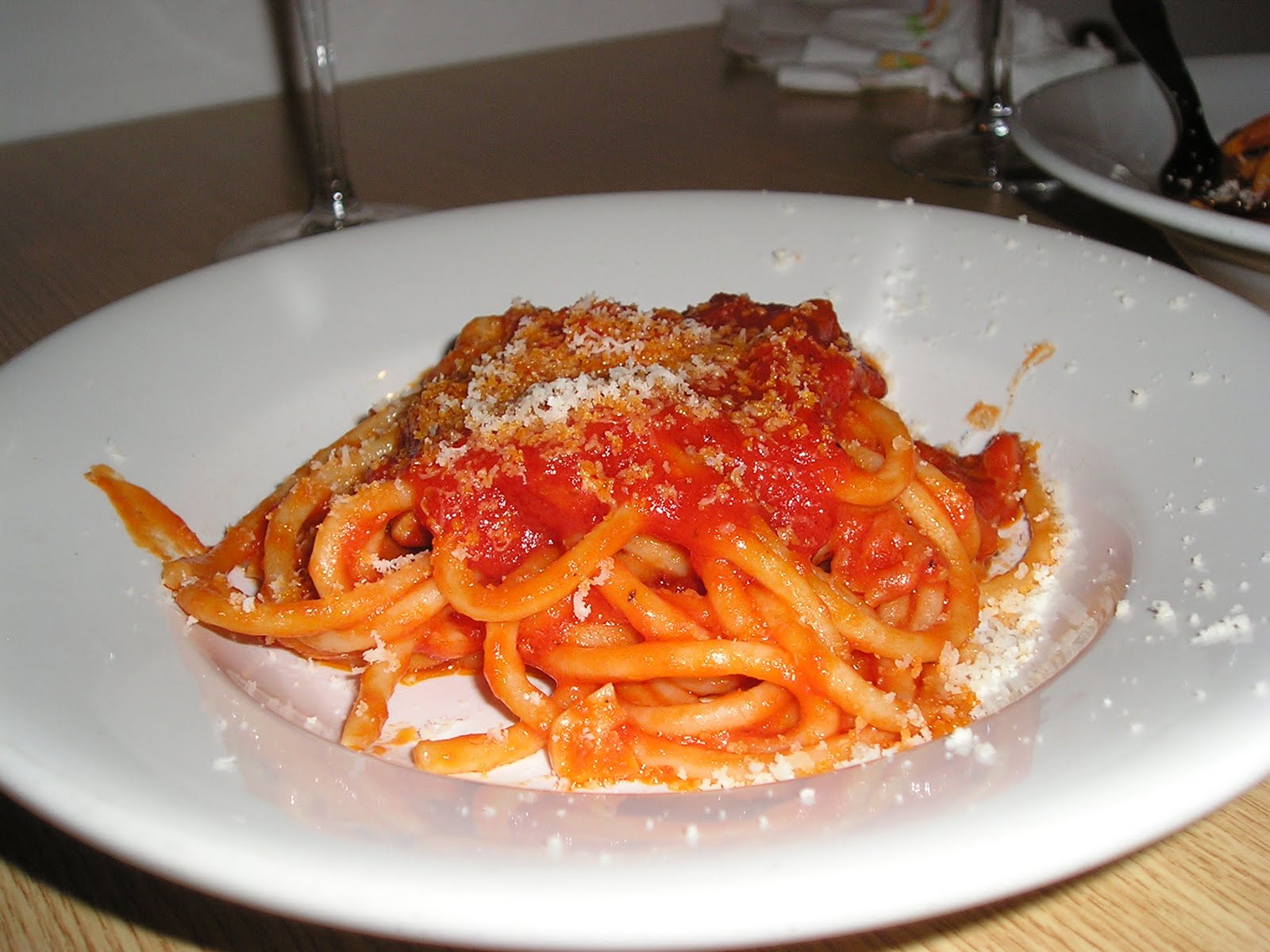
For the primo (pasta course), we had the long-awaited bucatini all’amatriciana. I had forgotten to pick up some hot pepper, so it wasn’t perfect, but it was still good. I made up for the absence of pepper with plenty of garlic, sautéed with the guanciale:


Then add tomato purée, a little black pepper, and toss it with the bucatini. A little cheese on top, naturally (traditionally Pecorino Romano, but Parmesan was what I had on hand):


The secondo (meat course) was another Roman classic, saltimbocca. The name translates roughly to “jump in your mouth”—it’s made from ingredients that, taken individually, are rather delicate, but collude in a finished dish that is quite robust.

Take very thin veal cutlets and layer them with sage and a slice of prosciutto:


For some reason, I remembered that saltimbocca included cheese (mozzarella), so I put some in, but now that I'm doing a little research online, it seems that this is not correct. I know I've eaten them with cheese before--maybe it's an Americanism.


roll them up and send them to the frying pan:


when they are done, eat them with relish.


A complete traditional meal would have included contorni (side dishes) of green vegetables and/or potatoes, but the dishes were already rich enough, so we just had a green salad.

Many thanks to Darlingtonia for sharing her pictures--some were taken with my camera, some with hers, but on the whole hers are much better. (My digital camera is seven years old, which to me seemed perfectly serviceable--I'm not really into technology--but I didn't realize it would be quite such a creaky antique when compared to the newer models. It offers a fraction of the megapixels of the newer models, eats AA batteries like there's no tomorrow, and my biggest memory card holds "only" 80 photos. Clearly I need to go shopping for a new camera when I get home!)

Coming soon: An excursion to a Renaissance palace; food tourism; and opera!
Later: A day in the life of a foreign language student; art history field trip; Venice!!!

Saturday, July 24, 2010

Buon giorno.

After years of resistance, I've finally succumbed and decided to join the world of blogging. The impetus is my upcoming trip to Italy: I'll be spending a month in Verona for a language study program, and hope to use this space to share my travel and foodie adventures with family and friends. I can't wait to explore the cuisine of the Veneto; the best part of the trip is that I will have a kitchen all to myself!

I'm getting a head start on my food-tourism. Today a neighbor brought over a bag of intensely sweet, perfectly ripe peaches from his backyard tree. Well, I know that bar-hopping in Venice will be a challenge on a student budget, so instead I decided to treat myself to a homemade version of the city's signature cocktail, the Bellini. I peeled and seeded the peaches -- they were so juicy I had to stop myself from eating them all! -- and pureed them with the juice of one lemon and a couple tablespoons of sugar. Then pour into a champagne flute and top with prosecco or other sparkling wine. Delicious. If only I'd remembered to take a photo.