Friday, September 10, 2010

The Bitter Berry / Il Mirtillo Rosso

“Faced with the challenge of explaining the cornerstone of Christianity, we did what any self-respecting group of people might do. We talked about food instead.”
-- David Sedaris, “Jesus Shaves”

So last night I was sitting in my apartment, eating yet another bowl of pasta e fagioli (what was I thinking, making such a big pot?!), and drinking the last of the Lambrusco I picked up in Mantova. (Man… when I drink Lambrusco here I can’t believe I ever liked the $5 stuff at Trader Joe’s. I mean, yeah, it’s cheap and it’s festive, but it’s so sweet, you can’t really drink it with food. The real Lambrusco is crisp, maybe a little bit sweeter than most reds, but definitely not sweet sweet. But I digress.)

So I’m sitting there having dinner, and I turn on the TV. And what happens to be on? The Simpsons! So I watch an episode of the Simpsons in Italian. One I haven’t seen in English, by the way, so I actually have to pay attention to the dialogue. And I’m pretty pleased that I can follow pretty easily. But…it’s so weird. Surreal, actually, to be watching it in another language. The episode starts with Homer voting in the Obama-McCain election. It proceeds through a parody of the Transformers movie, a parody of Mad Men and a Halloween romp, and ends with a Thanksgiving turkey—in Pilgrim costume, no less—bursting onto the scene. When Bart talks about eating a turkey dinner, the bird retaliates by chasing and gobbling the children.

And I’m sitting there wondering exactly how this reads to Italian kids watching the show. Certainly they are familiar with American pop culture—movies and TV shows and music—and from those they must get some familiarity with American holidays like Halloween and Thanksgiving. By a strange coincidence, our lessons that day had included some discussion of holidays. Ostensibly, it was for us to learn about Italian culture, but of course we all ended up discussing our own traditions.

Yesterday’s class was just me and two of the monks (they, too, are like parsley). (I know it probably seems a little weird that I keep going on about all the monks at my school. It’s just that their presence in my secular-humanist world is such a novelty. Plus all the ones I’ve met so far are pretty cool dudes.) Our teacher asked me to describe Thanksgiving, provided I used its Italian name, il giorno del ringraziamento. When did we celebrate it, she asked? Fourth Thursday in November. And this is the holiday where we eat turkey, right? Yes. And what else? Well, we eat the turkey with a sauce made from…wait a second… I looked up “cranberry” in my dictionary and found mirtillo, which is actually a blueberry. Huh? “The dictionary did not translate it correctly,” I said. “The dictionary says blueberry, but this is not correct. Blueberries are blue and sweet. The fruit we eat at Thanksgiving is red and bitter.” I said it was a type of berry, but this is another thorny bit of vocabulary. In Italian, berries are frutti di bosco, that is, woodland fruits. Cranberries don’t grow in the woods, they grown in a marsh. The teacher asked me if I maybe meant red currants. No, no… The Russian monk tried to help. He had eaten this fruit sauce, he said, when his best friend at his old monastery, an American, had cooked a traditional Thanksgiving dinner for the brothers. How they found cranberries in Vladivostok is a mystery, though.

It was the Ukrainian who finally came to the rescue. In his Italian-Russian dictionary, he found an entry for cranberries: mirtilli della palude, literally, bog blueberries. But even though we now had a name for them, we had only this perplexing description of a woodland fruit that grows in a swamp, is red and bitter, was cooked with sugar until it becomes like gelatin, and then is served with roast turkey. It sounds kind of dreadful, actually, doesn’t it? My mother describes her first American Thanksgiving as utterly perplexing—meat served with a fruit sauce? How bizarre! (Now she loves it, though, and makes the world's best cranberry sauce, in my humble opinion.) The concept is somewhat less foreign to Northern Italians familiar with mostarda, a fruit conserve that is served with boiled meats. In fact, when I first mentioned the cranberry sauce, my teacher said, with an understanding nod, “Like mostarda?” When we talked about Italians eating lentils on New Year’s Day, I had a similarly difficult time explaining the analogous American tradition of eating black-eyed peas (“they are called peas, but they are actually beans, and they are white with a black spot”), because no one knew what those were, beyond the name of the music group.

From traditional food the discussion moved on to traditional drinks, and there, we all understood each other perfectly: beer is good, but wine is better. Nunc est bibendum.

Thursday, September 9, 2010

San Zeno

Io fui abate in San Zeno a Verona
sotto lo 'mperio del buon Barbarossa...
I was abbot of San Zeno in Verona,
under the governance of the good Barbarossa...
--Dante Alighieri, Purgatorio XVIII.118-9

Today’s history tour took place in the eye of a storm. Last night it started raining; this morning, it rained; we had a brief respite in the afternoon, a couple hours of glorious hot sunshine, and then almost as soon as it got dark the rain recommenced, this time with lightning and window-rattling thunder. My apartment has a skylight, which is lovely, but now is letting in both noise and light, which is not exactly conducive to getting much sleep. Not that I’m complaining!

Today the fabulous A. led us to the basilica of San Zeno, which is the most beautiful thing I’ve seen in Verona so far. The original monument to San Zeno was built in the fourth century, shortly after his death; construction of the three-level structure that is the current basilica began in the 10th century, was destroyed by invaders and earthquakes, and was finally completed around 1380. The basilica was built on the site of the old Roman cemetery, in honor of the city’s patron saint, and has been remarkably well preserved. After the Scala family lost political control and Verona came under the power of the Republic of Venice, it also took control of San Zeno; the abbots of the basilica's monastery were all appointed by the Doge, but they lived most of the year in Venice, which meant they pretty much left the church grounds alone. On the one hand, this preserved all the artwork, including the extraordinary frescoes adorning nearly every wall; on the other hand, this meant the buildings were not well maintained, and the monastery itself collapsed in the early 19th century (I think! just for the record, I don't take notes during these tours :-). The church grounds, which are extremely large, represent only one-third the area of the medieval complex.

I don’t know whether the fault lies with my camera, which doesn’t seem to like to focus from a distance of more than a few feet, or with my own self because I’m a lousy photographer, but unfortunately many of the pictures I tried to take came out blurry, so I have fewer to share than I would like. But here are a handful:


As you can see, the church is covered with scaffolding because it’s under restoration, so I didn’t take any other exterior pictures. Inside, though:

Here’s San Zeno, who was the first Bishop of Verona. You can also see him in the detail of the portico, above. He is, naturally, always depicted with mitre and scepter, because of his status as bishop; he is depicted making a sign of blessing (three fingers extended) because he converted the Veronese to Christianity; and he is depicted with dark skin because he was thought to be African. Legend has it he was born in Mauritania, though A. points out that modern scholars think he was probably European. But because he wrote about other African saints, it was thought that Zeno was African as well. And, finally, he is depicted with a fish hanging from his scepter as if from a fishing-pole. His great friend St. Ambrose, the Bishop of Milan--the mentor of yet another African saint, Augustine--described Zeno as "a fisherman of souls," and so he is represented in iconography with a fish.


This is the tomb of Giuseppe della Scala (remember those Scala guys? come il prezzemolo), onetime abbot at San Zeno--late thirteenth century.


He won a spot in Dante's Divine Comedy, though not a favorable one (he appears in Purgatorio); he was criticized for taking the position in the church not out of religious faith, but in order to further his family's political agenda. Even if one questions his piety, there's no doubt that he was materially beneficial; for example, he paid for the restoration of the cloister:


If you look very closely, you may be able to see that there are two architectural styles visible. The arches in the center are rounded (Romanesque) while the ones in the shady area on the left are pointed (Gothic). The Gothic arches are the more recent ones, and were part of Giuseppe della Scala's renovation project.

And speaking of architecture, here's another nifty thing I learned on the tour. Notice the red-and-white stripes along the outside of the building? You see this everywhere in Italian Gothic architecture, especially churches, I think. It's very beautiful. But it was not done merely for aesthetics. The alternation of terracotta bricks with marble blocks was actually a technique for strengthening a building against damage from earthquakes. If you look closely at the photo below, you'll see that, in fact, the stripes do not line up perfectly--proof that it wasn't just for looks!


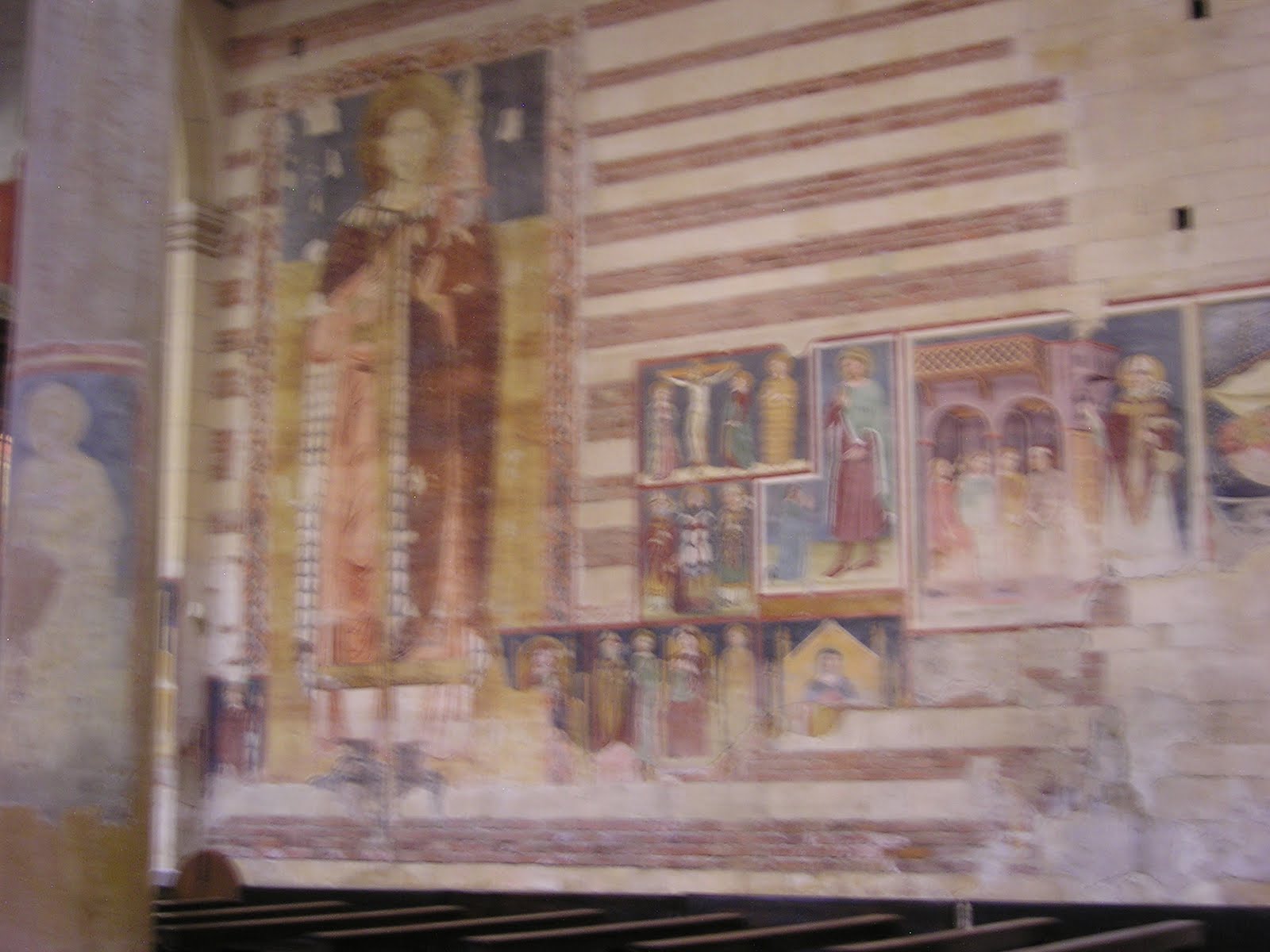
Both the outer walls of the cloister and the inner walls of the church are lavishly decorated with frescoes. I'm heartbroken that more of these came out blurry, but I hope they convey some sense of the visual richness of this place:


More famous than the frescoes, though, is the immense 15th-century painting by Andrea Mantegna that stands before the altar.


It has always been described as a tryptich, because it is divided into three panels, but art historians point out that it is mislabeled. In a triptych, each panel is a separate image with its own vanishing point. In this Mantegna piece, the three panels are part of the same larger image and share a single vanishing point in the central panel. But this piece has been known as "the triptych" for so long that it's hard to break the habit.

This photo does not even come close to doing it justice, but rest assured, it is splendid: vivid, detailed, expressive. The festoon at the top is a funeral decoration; although Mary is holding the infant Christ and surrounded by important saints, she has a look of melancholy. She is standing on a red carpet, but underneath that is depicted Christ's tomb. In this painting she is called Madonna vittoriosa sopra la morte, the Madonna victorious over death. For the moment, at least. She knows the Sacrifice is coming.

I won't talk about the fact that the painting was damaged when Napoleon ran off with it, nor that the three small panels at the bottom are quick copies because the originals have been in the Louvre since the nineteenth century... you'd think they would be willing to put them back in their original place rather than having the artwork piecemeal all over Europe.


The basilica is also famous for its enormous twelfth-century doors, each covered in 24 meticulously worked bronze plaques:


Each of the doors has a plaque of a single face with an open mouth; this, instead of a doorknob, was where you gripped the door to open or close it.


There is a series of four plaques representing the miracles of San Zeno. In the top right, he's exorcising a demon that has possessed a young girl; in the bottom left, he's saving a man from falling into the Adige River when his oxen (also, apparently, possessed) ran off with his cart.


The Last Supper (Judas is below the table, as if he could drop into Hell at any moment):

I'm pretty sure this one is Salome with the head of John the Baptist:


I got a huge kick out of the detail of the dinner table. Knife, cup, bread--very civilized, apart from that floating head!

And finally, one of the last things I saw as I was walking out of the church was this fantastic, immense manuscript:


It was unlabeled, and I won't embarrass myself by hazarding a guess at the date (I am not a paleographer). However, I did totally impress one of my monk-classmates (yes, "one of"--there are a few!) by reading the Greek aloud and identifying the text (John 1:1, for those of you playing along at home: "In the beginning there was the Word..." Thank you, Latin Carol Celebration, for drilling this passage into my memory!).

When I came home for dinner I was feeling too lazy to cook, and I’d had pasta e fagioli three nights in a row, so I threw together this salad, another Veneto classic:


It’s arugula, bresaola (air-dried beef), and shavings of grana padano cheese (the local answer to Parmesan). Light and fresh, but pretty filling because of the meat and cheese. In the US a version of this is served as “beef carpaccio,” but the original carpaccio, it seems, doesn’t have arugula in it; this dish is traditional for bresaola, not raw beef. (The “real” beef carpaccio, created at Harry’s Bar in Venice ca. 1950, is simply thin slices of beef with a mayonnaise-based dressing. It was named for the Renaissance painter Vittore Carpaccio [1460-1526], supposedly in homage to the vivid reds he used in his paintings.) But the combination of crisp, bitter greens and richly flavored beef is so seductive; almost every time I make myself a little steak at home, I plate it next to, or even on top of, a pile of arugula or occasionally watercress. The greens wilt a little from the heat and soak up the meaty juices, while still balancing the richness of the beef with their pungent herbaceousness. I love this combination so much that I will even order it in restaurants, breaking my personal rule of not ordering what I could easily make in my own kitchen. Earlier this summer I had a version of it at Nostrana in Portland, which does classic Northern Italian food with Pacific Northwest ingredients (in this case, local grass-fed beef). The chef drizzled the steak with a sharp garlic-rosemary-olive oil dressing. Simple enough to make at home, but so delicious and carefully prepared that it was totally worth restaurant prices.

Tuesday, September 7, 2010

Mangiafagioli

“What I love about cooking is that after a hard day, there is something comforting about the fact that if you melt butter and add flour and then hot stock, it will get thick! It’s a sure thing! It’s a sure thing in a world where nothing is sure…”
--Nora Ephron, Heartburn

I went to Venice last weekend. It was… I don’t have words. Or rather, I have too many words, and it’s going to take me some time to figure out which ones I want to use, so I’m afraid those of you reading this will have to be patient in waiting for the post(s) on La Serenissima. But it was amazing.

I left in a hurry on Friday, after school and a thoroughly delightful but longer-than-planned farewell lunch for a classmate. (Note to self: aperitivo + gnocchi + hot afternoon sunshine on Piazza Brà = a sluggish Buongustaia.) Starting with the mad dash from my apartment to the Verona train station, and ending with the mad dash through inscrutable Venetian alleyways to catch the last train home, the weekend was a nonstop blur of activity. I will spare you the lamentations for my poor, achy, blistered little feet, because the weekend was worth every blister! I had school Monday morning, of course, and after class, I was still groggy and sore. No energy to go out about town, and besides, I had things to do at home. The day was cool and overcast—almost no sunshine. Best way to fight the cloudy-day blues and post-travel fatigue? Cook!

One of my favorite cool-weather comfort foods is pasta e fagioli—pasta and beans. It’s warm and nourishing and soothing, like all the best soups, but it’s not quite a soup. When I had it in Rome it was beans and noodles and vegetables in a clear broth, soup-like, but in Northern Italy it’s more like a porridge, with the beans mashed, or simply cooked to the point of dissolution, to thicken the broth. In fact, the more I see of this dish in the North—both Tuscany and the Veneto claim it as their own—the more I think that the Roman version was gussied up for restaurant service, and not at all a typical preparation. But it was still delicious.

Borlotti are the beans traditionally used for this dish; in the US, cranberry beans make a fine substitute (they are similarly colored, white with rosy mottling). Pinto beans work in a pinch—I like them better than either cannellini or kidney beans, for color and texture—or you can use chickpeas and call it pasta e ceci. I actually already had a can of borlotti beans in the cupboard, thinking that, as the weather turned cooler, I might want to make this. But when I went to the vegetable market, they had fresh borlotti, and since they are in season, how could I pass them up?

I hadn’t been to the vegetable stalls in several days, since I needed to use up the produce I already had before leaving to Venice. It was, as always, fun and informative. I started with the carrots. The vendor bustled over and swatted my hands away. I was surprised, because normally customers are allowed to select their own vegetables. But she said, “Wait a minute—these carrots are no good. Let me get them out of the way for you.” She picked through the bin and selected half a dozen cracked or limp carrots, which she then laid to the side, and said, “There you go. Those others were ugly. These are beautiful. Go on, pick the ones you want.” So I did. And then I reached toward the celery: sturdy bunches with full heads of thick, dark green leaves. “You’re making a broth?” asked the vendor. I nodded, and she snapped two crisp stalks off at the root end and put them in the bag with the carrots. (This is totally brilliant, because while I like celery I don’t use it in that many things, and when I have to buy a whole bundle invariably it goes bad before I can use it all. Buying by the stalk is really ideal. Why don’t American grocers let you do that?) Next, “You need some onion.” This was not a question. “Red, white? How many?” “One white, please.” Garlic, or anything else? No, I had all that at home.


Pasta e fagioli is very easy to make, although it can be time-consuming. I usually make one of three versions: very slow, very fast, or not-too-slow.

The very slow version simply means that I start with dried beans and soak them and boil them. It takes hours, but then you get a bean broth, and it’s much tastier than canned beans. If I’m in a SlowFood mood, I also use homemade broth and (as I had it in Rome) scraps of fresh pasta dough instead of dried noodles.

The very fast version goes like this: Heat up some broth (chicken or veg, depending on your persuasion). Boil pasta in it. Whatever kind of pasta you have on hand. Smaller, shorter is better. If all you have is spaghetti or other noodles, just break them into little bits. When the pasta is cooked, add canned beans that have been rinsed and drained. Simmer a couple minutes until it’s all heated through, then season with salt and pepper, serve with a little olive oil and parmesan on top. It's a pale imitation of the real thing, but it’s still very tasty, and a great quick supper—takes barely 15 minutes, and I nearly always have the ingredients on hand.

The not-so-fast version makes a concession to the use of canned beans, and takes a little more patience than the fast-food version, but is more delicious and satisfying:

Start with a soffritto of onion, carrot, celery, and a couple cloves of garlic. There should also be herbs; at home I might use thyme, oregano and/or bay leaf, but since I didn't have any of that on hand I just used the celery leaves.


I need to take a moment here to say a few words about celery leaves. We’ve all had them in our kitchens, pretty much, because when we buy a bunch of celery it usually comes with the leaves. And most of us throw them away! Please, dear readers, do not neglect your celery leaves. They are fresh and herbaceous and aromatic and delicious. You can put them in salads (example: thin slivers of celery stalk, shavings of Parmesan, chopped celery leaves and parsley, dress with lemon juice and olive oil), or you can chop them up and throw them in with your soffritto or mirepoix or whatever cooking base you use. I always put celery leaves in my stocks. You can use it like any other herb in dressings, sauces, or even soft cheeses and compound butters. For example, there is a poem attributed to Vergil that describes a peasant’s lunch of cheese seasoned with garlic, oil, vinegar, salt, coriander, rue and comas apii graciles—celery’s delicate tresses. Delectable.

Anyway, back to our pasta e fagioli. Optional additions to the soffritto: a little tomato paste, a little lardo or guanciale, or, if you’re daring, a pinch of hot red pepper flakes. Add broth or water, bring to a boil. Add the beans (rinsed and drained, if using canned; if using dried beans, add their cooking liquid too). Once the beans are heated through, this is the step where you mash the beans, if you want a thick soup. At home I use an immersion blender and give it a few quick pulses, not enough to purée the whole thing, just to break up about half the beans. La nonna would use an old-fashioned food mill. If you don’t have either of these implements, a potato masher works just fine. Naturally, the immersion blender goes straight in the pot, but if you want to use a mill or masher, take out about half the beans with a slotted spoon, mash them and then add them back in.

If you have enough broth, and depending on how soupy you want the dish you be, you can cook the pasta directly in the pot. I personally prefer to do it this way, as I’m a fan of one-pot meals, especially on busy weeknights. You can also cook the pasta separately, in salted water, and add it already cooked to the pot of beans. (This is also a terrific way to use up leftovers, if you have some plain cooked noodles lying around.) Once everything is cooked through and quite hot, check the seasoning, ladle into bowls, and dress with a drizzle of olive oil, black pepper and Parmesan.


This is the first time I’ve made pasta e fagioli with fresh beans, and they took almost an hour to cook—but still, much faster than dried, and with a creamier texture and subtler flavor. I made a big pot so I’ll be eating it all week, but I don’t expect to get tired of it anytime soon!

Oh, and let's not forget dessert:

Thursday, September 2, 2010

A Day in the Life

Now that I’ve been in Italy for almost two weeks (!), I thought I might give a little description of how a typical day here goes.

School starts at 9:30am, and it’s only a 15-minute walk from my house. But I still get up pretty early so I have time for a leisurely coffee before I rush out the door. Morning coffee is a ritual. I have this mug at home, a cheery bright yellow mug with red printing, out of which I’ve been drinking my morning coffee for over a decade. It’s chipped all over, the pattern is scuffed, the handle has twice broken off and been re-glued, but it is my morning coffee mug and no other will do. I will mourn for that mug if it ever breaks irreparably.

In Verona, I make espresso in a little moka (a stovetop coffee-maker), and that is what I usually drink, especially if it’s a very hot day. Some mornings, though, I find myself missing my big American-style mug of coffee, and I will add hot water to make it a lungo (aka Americano if you're ordering at Starbucks), plus some milk. Breakfast is light, maybe some yogurt with a piece of toast or some fruit, occasionally an egg. The Italian word for breakfast is prima colazione, which means something like “morning snack”—not a full meal.

I have two convenient walking routes to school. One takes me past the Arena; the other takes me alongside the Castelvecchio. Both are beautiful. The Arena path is much nicer in the morning; when I leave campus in the afternoons, Piazza Brà is immensely crowded, mostly with tourists, people spilling out of the restaurants… the Castelvecchio way is usually quieter. Usually I walk one way to school and the other way back, just for variety.

My “commute” is enlivened by the occasional social encounter. People often stop me to ask for directions, which is always an ego boost as it means I don’t look like a tourist, at least to the casual observer—and if they want to get to the Arena or another main attraction I can usually even help. The locals are pretty chatty, too. The other morning I was waiting at a stoplight to cross the street. Next to me was a woman chatting away on her cell phone, making brisk arrangements for errands and appointments. As she hung up the phone, she turned to me and apologized for talking so loudly, but it was necessary: “Sono la factotum fuori da casa,” she laughed. “Sai cosa vuol dire, factotum?” Yes, and I giggled, because I’d never encountered it with the feminine article. “Si, lo so,” I said, “è una persona che fa tutto tipo di lavoro.” The light took forever to change and we kept chatting; here’s a rough translation of our conversation:
“Are you Italian?” the woman asked me. “Are you from here?”
“No,” I said, “I’m American.”
“Ah! Brava, you speak Italian very well. My son was studying in the United States, he speaks English very well. You should speak English with him. What part of the United States are you from?”
“I’m from California.”
“Ah! California is splendid! We have never been there but last summer we went to New York and Washington. New York was beautiful, especially Manhattan. Have you been to New York?”
Yes, I had, and yes, I agreed, Manhattan is beautiful.
“But tell me, there is one thing I worry about. Are there tornados in California? Because when we went to the United States I was very afraid that there might be a tornado. I do not think they have tornados in New York but I heard there are many in California. Is it true?”
“No,” I said, “there are no tornados in California,” and I wonder how such a rumor even got started! “The tornados are in a region called the Middle-West, it is halfway between New York and California.”
“Ah, good, well, then, nothing to worry about.” And then our paths diverged, so she waved goodbye and walked on before I could mention earthquakes.
For the rest of the morning I had stuck in my head that famous aria from Rossini’s Barbiere di Seviglia, in which Figaro declaims, “Sono il factotum della città!”

Sometimes the interactions are not so pleasant. Today a young man stopped me in the street and asked me a question, very earnestly—I assumed for directions or information—but so quickly that I didn’t catch a word of it. “I’m sorry,” I said, “Could you please say that one more time, slowly? I didn’t understand all of it.” He leaned in, towering over me. “I know you from somewhere, don’t I?”
“Um…no, I don’t think so.”
“I am sure I’ve seen you before. I wouldn’t forget that face. My name is Stefano. What’s your name? Aren’t you English?” He tried to grab my hand.
“I’m late for school,” I muttered, and set off at a quick trot, occasionally throwing a glance over my shoulder to make sure he wasn’t following me, wondering how he thought I’d buy that line about knowing my face when I was wearing these enormous sunglasses, and realizing with resignation that Italian men’s reputation for lechery does indeed, alas, have some basis in truth.

The first class session goes from 9:30am to 1:00pm, with a coffee break around 11:00. Very civilized; school should always be like this. We leave our books in the classroom and saunter down to the bar, where we drink a cappuccino. It’s also an ideal time for a snack, like a bocconcino (a tiny sandwich, just a plain little bun with coldcuts in it--no condiments, cheese or veggies) or a pastry. Those of us who feel inclined to economize might bring a piece of fruit or a yogurt from home instead; the proprietors don’t seem to mind. After half an hour we stroll back up to school to finish our lesson.

On Mondays and Fridays, the formal lessons end at 1:00; students have the afternoon free. On Fridays, this usually means heading out for a weekend excursion; on Mondays (in my case, at least), it means doing errands—bank, grocery shopping, laundry—and studying. (And writing this blog.) Tuesdays and Thursdays, we have an hour and a half break for lunch (again, as it should always be!). Sometimes we go out for pizza, but more often, I either pack a lunch or go home during the break, since this is more economical. Usually a sandwich, but this week I got creative with rice salad (also called riso alla greca), which is great because you can make it ahead. Start with cold cooked rice. Actually, since they only had rice in really big packages at the supermarket, I bought this blend of rice, farro and barley instead. I don’t know if it’s correct (certainly farro salad exists, but it’s done differently), but it’s delicious, and probably more nutritious than plain white rice. Anyway, you throw in some variation of chopped vegetables, ham, cheese, maybe some hardboiled eggs or beans or oil-packed tuna, and you season it with olive oil, lemon juice or vinegar, salt and pepper. Even better after it’s been refrigerated a few hours or overnight. After lunch we reconvene for two hours of conversation.

Our teacher, the delightful G., steers the discussion, teaching vocabulary and idiom; so far we’ve talked about modern art, cars and driving, family life, jobs, tourism, cultural stereotypes, and, sicuramente, food and cooking. It helps that we have a very friendly group; people like to talk. The intermediate and advanced students have conversation class together. The first week I was here, I was placed in the intermediate class; it was about right for my conversation skills, since I was years out of practice and am still working to recover everything I’d forgotten and to improve as much as possible, but it was also frustrating, because the grammar we were studying was very basic and I didn’t feel sufficiently challenged by the lessons. I asked the instructors if I could move up a level, and on Tuesday I was placed with the most advanced students. There are just three of us and we’re knee-deep in the marshland of subjunctive verbs, tense sequences and conditional phrases, which is exactly where I need to be. The grammar exercises stopped being easy, so I feel I’m getting much more out of them!

On Monday, the intermediate and advanced students had language lessons together, and we were assigned a composition exercise. We were given a series of three pictures and told to write a story based on these images, in groups of two or three:

I was grouped with the two other advanced students. We also happen to be the youngest students in this section by far, and, apparently, the ones with the most vivid imaginations. Disclaimer: I didn’t come up with the plot twist; that was the inspiration of one my classmates, who is also a monk. No, really. He lives in a monastery and everything. Apparently these Franciscan novices have a slightly twisted sense of humor. (Confidential allo babbo: io non ho scelto il nome di nostro protagonista!) Here’s our collaborative effort, errors and all:

Una bella mattina, Giorgio si svegliò alle 7 e mezzo. Guardò la finestra e vise il sole che sorgeva. Era lunedì, e Giorgio sapeva che sarebbe dovuto andare a lavorare, ma mentre faceva la barba, decisi di non andarci. Andò invece a fare una passeggiata nel bosco vicino. Giorgio sapeva che il bosco era molto pericoloso, però andò lo stesso. A un certo punto, mentre camminava, e apparso un lupo grande e di aspetto cattivo. Giorgio aveva due scelte: arrampicarsi a un albero, o lottare contro questa strana bestia. All’ improvviso, Giorgio si ricordò di quanta trista era la sua vita: abitavo da solo, non aveva ne amici ne parenti. Avevo soltanto un compagno: l’alcool. Allora si è arreso all’ attacca del lupo, e così morrì Giorgio, l’uomo più sciocco mai vissuto.
One beautiful morning, Giorgio woke up at 7:30. He looked out the window and saw the sun rising. It was Monday, and Giorgio knew he was supposed to go to work, but while he was shaving, he decided not to go. Instead he went to take a walk in the nearby woods. Giorgio knew that the woods were very dangerous, but he went anyway. At a certain point, while he was walking, a big, mean-looking wolf appeared. Giorgio had two choices: to climb a tree, or to fight this strange beast. Suddenly, Giorgio remembered how sad his life was: he lived alone, and had neither friends nor family. He had only one companion: alcohol. So he surrendered himself to the wolf’s attack, and thus died Giorgio, the most foolish man ever seen.

I warned you it was twisted.

Wednesday afternoons we have an excursion around town with the art history instructor; last week it was a tour of the Roman ruins. This week: Medieval Verona.

Conversation finishes at 4:30, excursions slightly later. Once in a while we students will do something as a group, like meet for drinks or go see a movie, but most nights we are left to our own devices. I come home and drop off my backpack before going for a walk or running an errand—for example, to the vegetable stands at Piazza delle Erbe—and then come home, take as much time as I feel like to cook dinner, and sit down to write or read. (I fully admit that right now I’m reading purely for pleasure, mostly mystery novels. But I’m on my last one, and then I’m only going to read books in Italian for the rest of my stay!) Occasionally I turn on the TV while fixing dinner, just for the extra language practice, but on the whole I’m rather cut off from the world when I’m at home; I don’t have Internet access in the apartment, and since there is no land line and I only have my American cell phone (expensive to use here), I rarely talk to anyone else. I thought I’d be bored and lonely without my communication toys and mindless entertainment, but quite to the contrary, I am loving this quiet solitude. I enjoy having the time to read and write purely for fun. And yet I’ve still been able to have a real social life while I’m here! Believe me, I won’t be ending up like poor old Giorgio…

And by the way, please don’t think I was making fun of our friend Mr. Monk or being disrespectful. I fully respect his chosen course. Although I’m not religious, I do think I understand what it’s like to have a vocation. I’m not on my chosen career path because it will make me rich or famous, nor because it is convenient or stable or even remotely straightforward. I chose to become a scholar not only because I wanted to; I felt I needed to. I could not—cannot—imagine finding satisfaction in a life that is not dedicated to the pursuit of knowledge and also to its dissemination. Some of us are called to our careers by God, others by Philosophia. Had I lived in Verona in its Scaliger heyday, I feel quite certain that I would have gone into the Church for this very reason: a convent was for centuries the safest space, sometimes the only safe space, in which a woman could devote her life to study.

Verona Medioevale

Inclyta vestrae Magnificentae laus, quam fama vigil volitando disseminat, sic distrahit in diversa diversos, ut hos in spem suae prosperitatis attollat, hos exterminii deiciat in terrorem. Huius quidem praeconium, facta modernorum exsuperans, tanquam veri existentia latius, arbitrabar aliquando superfluum. Verum ne diuturna me nimis incertitudo suspenderet, velut Austri regina Hierusalem petiit, velut Pallas petiit Helicona, Veronam petii fidis oculis discursurus audita. Ibique magnalia vestra vidi, vidi beneficia simul et tetigi; et quemadmodum prius dictorum ex parte suspicabar excessum, sic posterius ipsa facta excessiva cognovi. Quo factum est, ut ex auditu solo cum quadam animi subiectione benevolus prius exstiterim; sed ex visu postmodum devotissimus et amicus.
The illustrious praise of your Magnificence, which tireless Fame spreads on the wing, pulls different people toward different places, so that she lifts some up in hope of prosperity, and casts others down in dread of ruin. This proclamation of fame that surpasses the deeds of modern people, as if beyond the truth, I considered rather exaggerated. In fact, so that this uncertainty would no longer keep me in so much suspense, as the Southern queen came to Jerusalem, as Pallas came to the Helicon, I came to Verona to see with my own eyes the things I had heard about. And there I saw your great deeds, I saw your benefices and I even touched them; and just as I had previously suspected an excess in most of what was said about you, afterward I understood that the deeds themselves were in excess. So just as by only hearing of you I thought well of you by an influence on my mind, now through seeing you I have become your most devoted friend.
--Dante Alighieri, letter to Cangrande I della Scala

Another Wednesday, another walking tour with our fabulous art history teacher, A. This week’s theme: Medieval Verona, or Verona Scaligera—Verona under the rule of the Scala family.

Our first stop was the Castelvecchio, the fantastic medieval fortress at the city’s center. It’s also home to a vast art museum, which will deserve its own post shortly; I visited it with Darlingtonia last Friday and we took about a million photos. Here are a couple exterior shots:

The Scala family ruled Verona and the surrounding area during the thirteenth and fourteenth centuries. The castle, surrounded by a moat and backed up against the Adige River, was isolated from the rest of the city, a protective measure against political aggression.

In Verona, as elsewhere in medieval Europe, political party lines fell across an impassable divide: either you were a supporter of the Pope (Guelph), or you were a supporter of the Holy Roman Empire (Ghibelline). These divisions were so ingrained that they were literally built into civic life. Take a look at this:


These crenellations or battlements (in Italian, merlatura—many thanks to A. for teaching us all this specialized vocabulary en route!) have this characteristic design of two lines curving inward to a central point—like a deep M. This is called the coda di rondine, or swallow-tail, motif, and it is the marker of the Ghibellines. The Guelphs, on the other hand, topped their edifices with squared-off crenellations, sqaudrati. Any visitor knew at a glance where his landlords’ loyalties lay. When the Pope came to Verona, he would stay across town—in fact, in my neighborhood—where most of the Guelphs lived. The Emperor would stay at the Scala castle, or at the nearby church of San Zeno, which belonged to the Ghibellines.

By the way, I learned another great word today, and I kind of can’t believe I didn’t learn it sooner. A. was telling us about the importance of the Scala family as artistic and literary patrons; they sponsored both Dante and Giotto. The Italian word for patron is mecenate. And here’s why it’s so cool. It should be written Mecenate, because it’s the Italianization of the Latin name Maecenas. Gaius Cilnius Maecenas was an intimate of Octavian (later Augustus Caesar), and pretty much originated the system of literary patronage that continued through to the Renaissance. He funded Vergil and Horace, as well as other lesser-known poets, establishing a literary circle at the imperial court and setting a precedent for the support of artists by both private and public benefactors. So in Italian, all partrons are Maecenases.

Our next stop was the Piazza delle Erbe; if you read this post you’ll have already learned that it’s the former site of the Roman Forum. The forum was still a bustling marketplace during the Middle Ages. At the center is this little structure:


Notice the heavy metal ring chained to the column.


Most visitors assume this is some sort of medieval torture device, but in fact it’s something quite practical and mundane: a standard measure for the sale of firewood. You would fit a bundle of wood into that ring, and pay for as many bundles as you needed, assured that the bundles were all exactly the same size.

On the second step below this ring are the following imprints:


They're perhaps not very clear in the photo, but these were mold prints used to standardize sales of bricks and roof tiles. Your brick or tile had to fit exactly; if it was too small or misshapen, it could not be sold. If you ever wondered how quality control was achieved in medieval commerce, here’s your answer! The interior of the structure also, we were told, was marked with a standard measure for lengths of cloth.

Facing this structure, under the archway that leads out toward the Piazza dei Signori, is this curiosity:


It’s a whale’s rib bone, which was supposedly brought from China. It’s also a storefront sign. Given that the majority of medieval people were illiterate (analfabeti), merchants often advertised their wares with pictorial signs and objects. For example, a jeweler might put out a little placard covered in gold leaf. The whale bone, because it came from China, was supposed to promote a store at which one could buy silks, spices, and other materials imported along the Silk Road, shipped from Venice to Verona along the Adige. As A. pointed out, gesturing toward the stalls of cheap souvenir toys, one can still come here to buy merchandise made in China.

The symbol of the Scala family is a ladder (una scala), which appears on their coat of arms (stemma) and all over the city. A. claims that if you want to flatter the modern Veronese, you should refer to them as Scaligeri, the modern-day incarnations of the great rulers. You can hardly walk five steps without seeing that ladder on a building or artifact. In fact, there’s a saying: gli Scaligeri sono come il prezzemolo, the Scaligeri are like parsley. It’s a common idiom, in Italian: to be like parsley means to get oneself into everything. Kind of like, in English, having a finger in every pie, but more pervasive than that, and at once a benefit (parsley is tasty and healthful!) and a nuisance (why are there these little green bits everywhere?). The Palazzo della Ragione, which housed the justice courts, built in the twelfth century and renovated by the Scaligeri at the height of their power, just underwent a massive restoration, which cost something in the neighborhood of €26 million.


Apparently they’re still finishing it up; the courtyard entry was blocked, and there was a giant crane lifting workmen up to the roof. The name of the crane’s manufacturer caught my eye:


Just like parsley.

The last stop was the Arche Scaligere, the Scala family tombs, beautiful examples of Venetian Gothic architecture. Notice the ladder motif in the iron gates, on the sarcophagi, and on the coats of arms, often accompanied by the imperial eagle.


This is the tomb of Cangrande I, Dante's mecenate. Notice the crowned dogs each holding a stemma; "Cane Grande," the big dog.


The equestrian statue atop this monument is said to have been inspired by Chinese terracotta sculptures, described by Marco Polo.

Wednesday, September 1, 2010

Mantua, Part II

I mentioned earlier that Verona is in the region of the Veneto. Mantova is just over the regional border in Lombardia (Lombardy), and even though it’s only a half-hour train ride away, it’s a different culinary world. Lombard is probably best known for its rice dishes and stuffed pastas, and for a sparkling red wine called Lambrusco.

First stop on our foodie tour was this beautiful pastry shop:


We picked up an assortment of goodies to sample. We brought them back to Verona and by Monday had devoured them all: sbrisolina, a cornmeal shortcake, crumbly and not too sweet, with a pleasant savory counterpoint from the whole roast almonds contained in it; a delectable conchiglia (shell-shaped pastry) filled with chocolate and pears; an offella (tartlet) containing a dense, sweet layer of quince paste; a capricciosa (diamond-shaped pastry) with cherries and cream. The most foreign-to-us item was the torta di tagliatelle, composed of fine, slightly crunchy egg noodles layered with a buttery, sweet-spicy filling. Most of you reading this already know that I dabble in culinary history—it’s only natural that my personal interest in food and my scholarly interest in history and cultural studies would intersect, no? Anyway, the combination of the noodles and sweet-spiced filling reminded me of some sixteenth-century pasta recipes. In the cookery books by Cristoforo di Messisbugo (the majordomo of the Este palace in Ferrara, early 1500s) and Bartolomeo Scappi (head chef for Pope Pius V, Rome, mid-1500s), there are a number of variations on this theme: fresh noodles or gnocchi (dumplings), made with or without egg, seasoned with butter, sugar, cinnamon and cheese. This includes layered pasta dishes, such as lasagne. (Sound peculiar? I’ve tried making a couple of these recipes and they’re unexpectedly delicious.) This sweet may very well be a direct descendant of those preparations. I found several websites with recipes and descriptions of this sweet, but none of the ones I've seen so far attempt to trace its history. There seems to be some debate as to whether the torta should have a short-crust base or not (the one we had didn't), but that aside, all sources agree that the key ingredients are fresh egg noodles, preferably homemade, with a filling of butter, ground blanched almonds, sugar and cinnamon. I might take a crack at making this someday—funny, I never thought I’d use my pasta machine to make dessert!

On the walk to the Teatro Bibiena we’d passed a couple of food shops and eateries (including, disconcertingly, a McDonald’s), so after our pastry-buying binge we turned back along Via Accademia to investigate.

First was a very charming combination of delicatessen (La Boutique del latte—the milk boutique) and bookstore (Il Pensatoio – la librogusteria—The thinkery – the book-tastery?). The food side had mostly cheeses, plus wines and local specialty products; the book side had fabulous art books and cookbooks and novels and music and movies. If the academic job market is still slumping by the time I graduate, maybe instead I should think about opening a shop like that one…

Even though the point of this whole trip is to get friendly with Italian language-culture-gastronomy, when I saw the fabulous display of French cheeses, I couldn’t resist it. They had a Coulommiers, which is one of my very favorites: a gloriously stinky creation that I have never yet been able to find in the US, even in specialty cheese shops. It reeks of a barnyard and tastes of an earthy paradise. This one was quite mature, with a rind that was more blush than white. Darlingtonia had never encountered this cheese before, and we decided that such an aggressively smelly delicacy simply had to be introduced into her gastronomic curriculum. For when else, after all, would she next have an opportunity to taste it? Despite my warnings and the potent aroma emanating from the shopping bag, I am not sure that she was quite prepared for its pungency. Even I had to trim the excess rind from the slices I ate—and I was raised to believe that it is anathema to cut the rind off a soft-ripened cheese! Our beloved home state of California produces some exquisite cheeses, but none are as bracingly pungent as the good French stuff, and I sometimes think that, just as I’ve lost my tolerance for humid summers and snowy winters, my tastebuds have gone soft, too accustomed to the plush luxuriance of a Mt. Tam or a Humboldt Fog. We Americans are starting to pull away from our Puritanical roots where food is concerned—witness the rising triumphs of SlowFood and nose-to-tail eating—but even though we’re eager to sample artisanal breads, heirloom vegetables and heritage livestock, even though we quaff biodynamic wines and obsessively hunt down single-origin chocolates, we are still a little fearful, I think, of soft-ripened cheeses that are authentically and intensely stinky, redolent of humus and decay. Oh, sure, you’ll come across the occasional Epoisses or Pont L’Eveque, but most of what’s fit for USDA-certified importation is bound to be on the milder end of the pungency scale. And besides, there’s something naughty about eating these cheeses…something dirty, almost transgressive. We shouldn’t be putting our mouths near anything that smells like that—and yet we do, and what’s more, we love it, we keep on doing it, we crave it.

Whew. Sorry for the digression. Ricominciamo:

We didn’t actually eat the cheese in Mantova. We brought it back to Verona and had it before dinner the next night. But we did want a snack before going in search of our dinner, and we passed by an enoteca (wine bar) with a tantalizing display of hors d’oeuvres piled all along the bar. A crowd was starting to gather, so we popped in to see what the deal was. It was a very good deal. For €4 each we got a glass of excellent dry Prosecco, and were at liberty to sample as much as we wanted of the appetizers:

schiacciata (flatbread) with tomatoes
herbed green and black olives
frittata
mortadella di Bologna
Parmiggiano-Reggiano cheese, in chunks
crostini: salame; shrimp; tuna; cheese and wurstel (a thin, bratwurst-style sausage)
bocconcini (tiny sandwiches) of salame and mortadella
tomato bruschetta
salad of zucchini, cheese and wurstel
carrot sticks
pasta salad
rice salad

I wish this setup would catch on in American bars; it’s brilliantly simple, economical (because no wait-staff is needed) and convivial. The enoteca drew singles, couples, even families with small children! And if you didn’t want to crowd around the bar, you could fix yourself a plate and enjoy your wine and snacks at an outside table.


We didn’t eat much because dinner was imminent, but we did sample a few bites and they were all very tasty. Then onward to the restaurant, Hosteria Leon D’Oro, which promised authentic Lombard cuisine. We sat outside in a picturesque alleyway and were given handwritten menus. There was a two-page preface explaining why there were no fish dishes on the menu, because they changed at every meal service depending on what was fresh, and that we would have to ask our server, and explaining that even though the Hosteria was committed to showcasing locally sourced ingredients, the seafood was all flown in from Sicily, because it was quite simply the best available. The descriptions of individual dishes were often a full paragraph long. Sorry I didn’t get any photos of the original menu, but here’s what the English version (they only have one copy for the whole restaurant) looks like:


Since we were in Mantova, we ordered a bottle of Lambrusco to drink. I’ve had Lambrusco in the US, but usually it’s too sweet; this one was crisp, with a strong head of bubbles, and was served properly chilled. Very refreshing, and it went nicely with the first two courses.


We started with a very simple antipasto of grilled polenta squares, each topped with a different cheese—Gorgonzola, Fontina (Val d’Aosta), and Brie—and broiled until the cheese was melted and bubbly, then dusted with freshly ground black pepper and crushed toasted hazelnuts. It could hardly have been less complicated or pretentious, and yet it was elegant, memorable and of course delicious. I’m totally serving it at my next dinner party.


For our primo we had the famous local specialty, tortelli di zucca. These are little stuffed pastas filled with a spiced purée of winter squash and served with a minimalist dressing of melted butter and sage. There are few things more scrumptious than this dish, when it is properly prepared, and the fabulous chef (did I mention that the Leon D’Oro is owned and operated by a woman chef?) did a superb job with it.


The secondo was a filet of Tuscan beef with mustard sauce, served with white beans in olive oil and parsley (so very Tuscan). Again, fairly simple, but hearty and full-flavored. We didn’t order contorni, figuring that we already had plenty to eat.


No room for dessert, but we did finish with a caffè corretto, that is, an espresso “corrected” by the application of booze, in this case Sambuca.


The best part: This three-course meal, including coperto (a cover charge for bread and service), wine, bottled water, coffee and liqueur, cost us about €30 each. Still a bit of a splurge, but an outstanding value given the quality of the food and service. Better yet, the Leon D’Oro, unlike most American restaurants, did not charge us for splitting the plates, and the portions were still plenty generous (I couldn’t imagine just one person ordering all that). If I ever come back to Mantova, I am definitely eating here again!

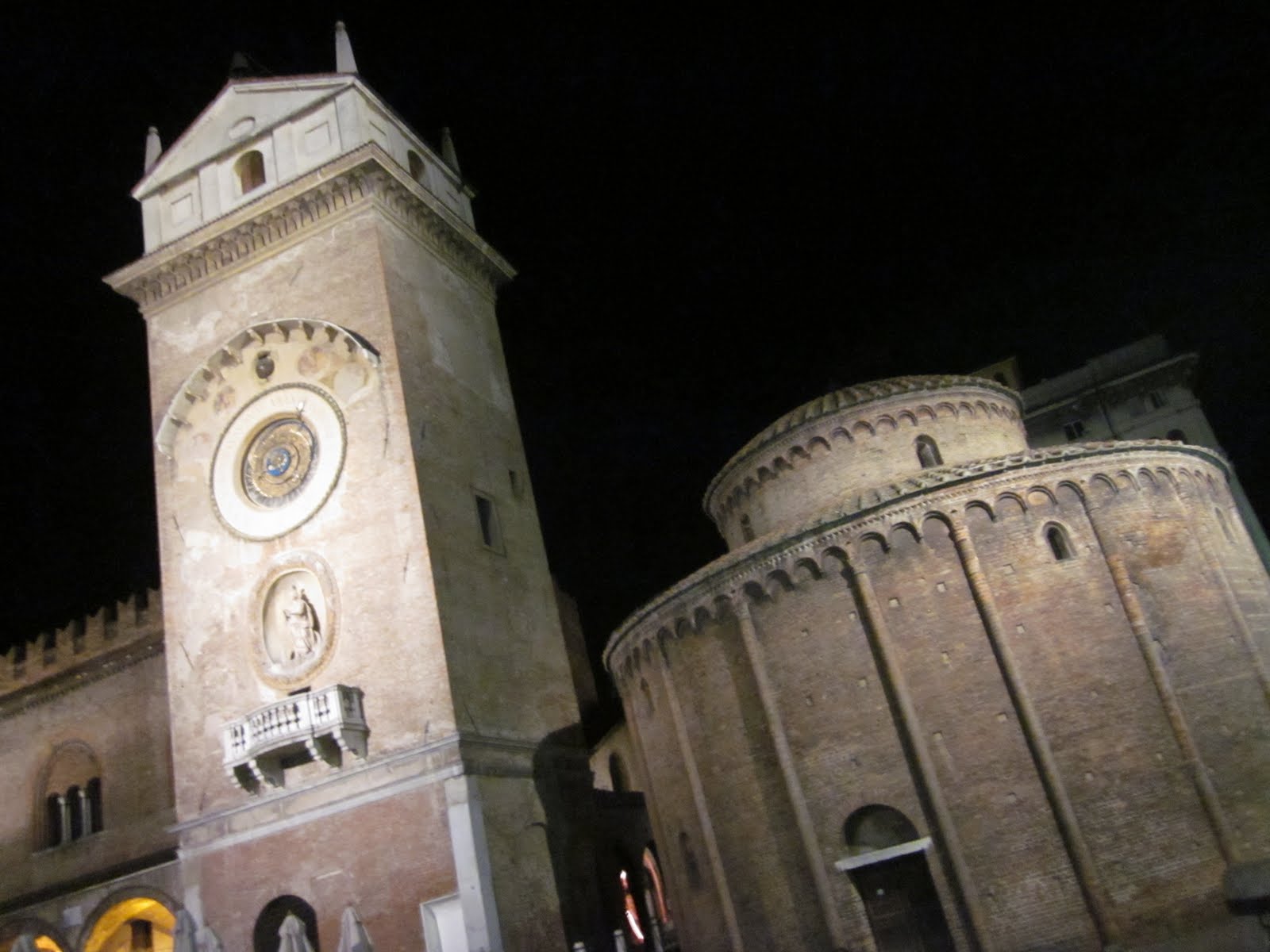
On the way into town we had taken what seemed, according to the map, the best route from the train station; but it was visually uninteresting, and a little isolated. On the way back to the station we cut through the center of town, which was much more lively and attractive (and felt quite safe), even at 10pm. Just past the restaurant we spotted this gorgeous building:


The nighttime photos don’t do it justice, and because it was late and we had to catch a train there was no chance to stop and investigate. But this is the most marvelous thing about Italy: there is something wonderful to look at almost everywhere you turn. You’ll never get to see all of it; if you’re lucky you’ll find something out about a fraction of the artworks in this aesthetically splendid country. These architectural grand-dames confront you literally around every corner, looming, challenging, but also strangely comforting, reminding you that there is sometimes permanency in worldly beauty.