Saturday, January 11, 2014

Christmas Baking


The holidays have come and gone, but I'm only just now getting around to the photo- and recipe-sharing part.

My family hosted a Christmas Eve buffet dinner for 14 people. We tried to keep the dishes fairly simple, and came up with a menu where we could do a lot of prep work in advance and cook almost everything in the oven, so we could have a relaxed evening and not be chained to the stove!

About a week earlier I'd been to a party where the hosts served a delicious flatbread topped with apples, blue cheese, and walnuts.  I decided to make a variation on this as an appetizer, using quince rather than apples since we had some on hand.  I made a basic pizza dough and topped half of it with crumbled goat cheese, and the other half with bacon "jam" (a confit of slow-cooked bacon and seasonings, for which I can take no credit -- it was made by C. and M.)  Over this went slices of quince, sautéed in butter with brown sugar, salt, and black pepper; fresh thyme; thinly sliced shallots; pecans.

before

after
I failed to get photos of the other appetizers, which included olives, salumi, cheeses, and endives with a blue cheese and walnut spread (a perennial favorite).

buffet
Salad: Romaine hearts, cherry tomatoes, parmesan cheese, chopped toasted pistachios. Pistachio oil and blood orange vinaigrette.

Roasted green beans and yellow and red bell peppers; walnuts and mustardseed.
The salad dressing, the baked chicken, and two of the desserts below include blood orange in the ingredients. This isn't for want of creativity; it's because my parents have a very prolific blood orange tree!  All the fresh herbs and other citrus fruits (lemons, limes) used in this meal are homegrown.

Chicken pieces baked with onions, garlic, green olives, blood oranges, fresh oregano.
The pasta dish was inspired by a fabulous movie, Haute Cuisine, based on the career of the first woman who worked as a personal cook for the president of France. Early in the film she describes a "gratin de macaronis aux cèpes," or a baked pasta with porcini mushrooms.  It sounded so delicious that I had to try it!  Fresh porcini can be hard to find and fairly expensive, but dried ones are more economical and intensely flavorful.

Soak dried porcini in hot water for about 20 minutes; drain, chop, set aside. Strain and measure the remaining porcini water. Make a béchamel sauce (roux + milk) but swap out about half the milk for the porcini water.  The roux is made using equal parts flour and butter: one tbsp each plus one cup of liquid. Melt the butter, and cook the flour with it until it is slightly golden and the raw-flour taste has cooked out; then whisk in the liquid. For one pound of pasta (I used penne; any short pasta will do), you will want at least 4 cups of sauce (4 tbsp each butter & flour, 4 cups liquid).  This dish is great for parties since the pasta and sauce can be cooked (separately) in advance, then combined and baked just before heating. Remember to toss your cooked pasta with olive oil so it doesn't stick, and leave it slightly underdone (more than usually al dente) -- it will continue to cook in the oven. Bake at 375 F until browned and bubbly.

Porcini pasta gratin. Topping: breadcrumbs, parmesan cheese, garlic.
And finally -- of course! -- the desserts.

Ricotta cheesecake with pomegranate and blood orange syrup, both made by C.

These are our traditional family recipes; the cookies, pudding, and cake appear every Christmas. Sometimes we'll add other items to the menu, but it is not Christmas without these three items on the table!
Sablés (sugar cookies)
The pudding is a Lebanese specialty called mighli. It's made simply with water and rice flour; sweetened with sugar, and flavored with cinnamon (hence the color), anise, and other spices. It is delicate and delicious.  The pudding is allowed to cool and then topped with shredded coconut and nuts. It's traditionally made for the birth of a baby -- which is, naturally, how it came to feature in Christmas meals. 

Mighli without garnish. Like any pudding, it can be served either in individual cups or in a large dish.

Mighli topped with shredded (unsweetened) coconut, walnuts, and pine nuts.

And the pièce de résistance: the bûche de noël, or yule log cake. It's made by the same process as a jelly roll: a basic sponge cake batter, baked in a sheet pan, then rolled up while still warm and allowed to rest in a roll overnight so it holds its shape. We make the bûche every year but sometimes vary the flavorings of the cake, filling, and frosting. This year the cake was flavored with blood oranges (zest and juice); the filling is vanilla chantilly cream; the frosting is dark chocolate ganache. Chocolate curls and powdered sugar are added for extra decoration, to give the illusion of snow-covered tree bark.


I hope your holidays were as delicious as ours!

Sunday, December 8, 2013

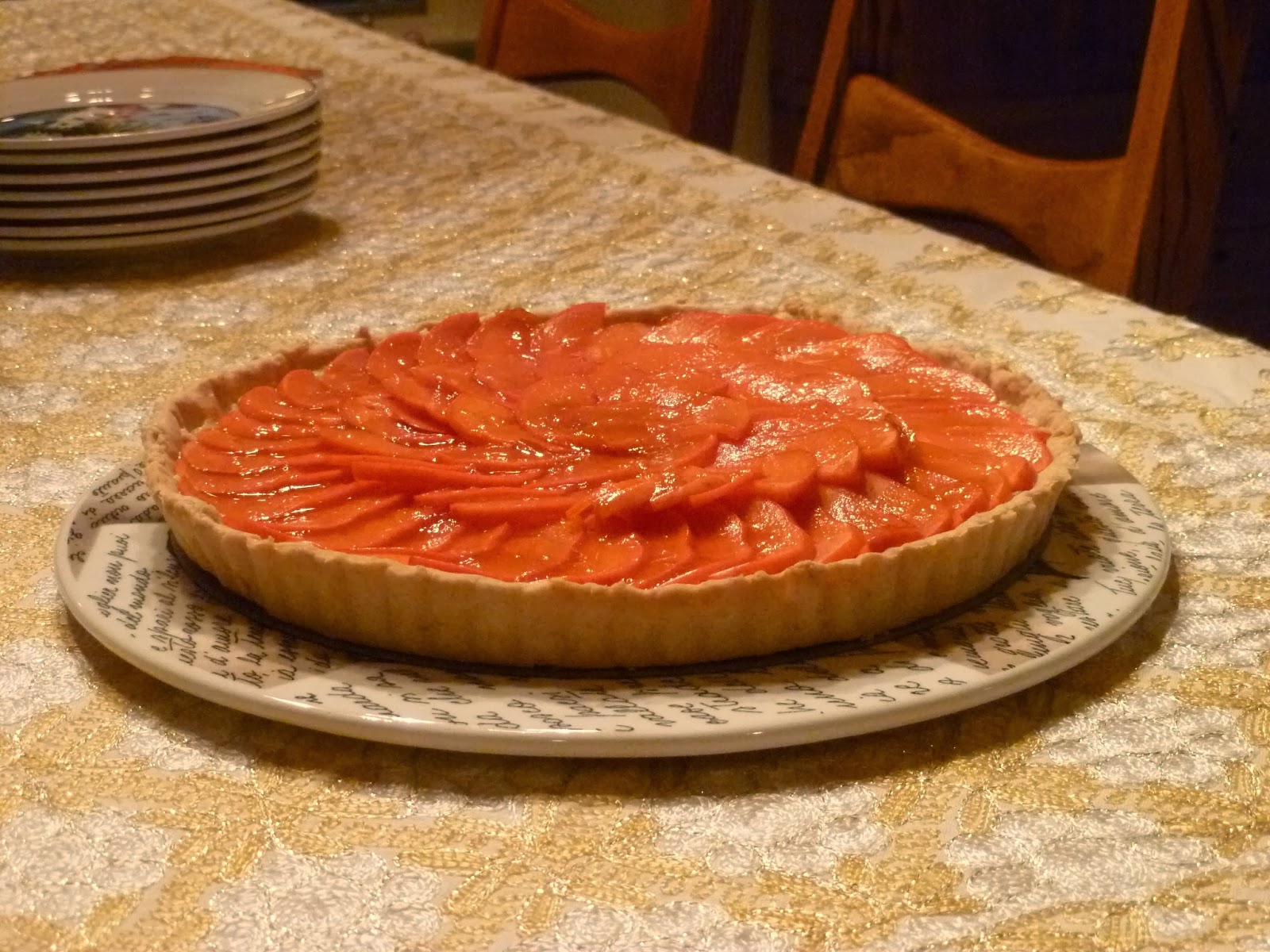
Persimmon Tart


In summer, I love to make fresh fruit tarts when berries are in season (there's an example in miniature here). But using fresh strawberries or raspberries in December just doesn't feel right to me. Instead, I decided to try the same formula -- short crust, pastry cream, and fresh fruit -- using a fruit that is actually in season.  Persimmons!


Persimmons and tart shell (shortcrust or pâte brisée)

Persimmons are abundant at this time of year in California. There are two common varieties. The hachiya has a soft, juicy pulp when fully ripened; this is the type of persimmon most commonly used in baking (in quickbreads, cookies, and cake). My favorite kind is the fuyu persimmon, which is sweet and crisp: you can eat it like an apple. They are a wonderful addition to fall salads, too; at this time of year I like to enliven a green salad with sliced persimmon, toasted pine nuts or almonds, and pomegranate seeds.

A couple weeks ago I had the whim to make a snack of persimmon slices with almond butter (delicious, by the way) and got to think about an almond and persimmon dessert -- but using fuyus, not hachiyas, since we had so many of them at home already.  I decided to try a variant on my summer fruit tart, using persimmons instead of berries, and an almond-based pastry cream.

Ingredients: Butter, confectioner's sugar, ground blanched almonds, cornstarch, rum, vanilla pastry cream.

My almond pastry cream is a variation on the one in the Lenôtre cookbook (pictured). The base is butter, ground almonds, and confectioner's sugar; this almond cream is then combined with a roughly equal amount of vanilla pastry cream.

The finished almond cream. It was difficult to resist the urge to lick the bowl clean.

The pastry cream is chilled, then spread in a thin layer in the tart shell.  I fanned the persimmons over the top, then finished it with an apricot glaze (apricot jam, heated, and diluted with a splash of rum). No baking required, aside from the tart shell.


The tart had its first outing at a little dessert party. I also made a chocolate pudding, one of the ultimate comfort foods in this unseasonable-for-California cold snap.

Pudding: milk, dark chocolate (Callebaut 60%), sugar, cornstarch. Orange zest and Grand Marnier whipped cream.

People seemed to like it.


Tuesday, October 30, 2012

Apple Harvest

          as the sweetapple reddens on a high branch
                                       high on the highest branch and the applepickers forgot--
no, not forgot: were unable to reach
             -- Sappho, translated by Anne Carson


A few weeks ago, several friends and I went tromping through the property adjacent to my house to pick apples. It's a large expanse of wild land-- a dried-up creek bed, stands of redwood trees, blackberry brambles. Weeds and hay, overgrown dandelions, oak trees, the occasional patch of poison oak . . . and the remains of an apple orchard. Since I moved here we've found three trees with plentiful fruit. I suspect there are more we haven't discovered yet, but before we'd even made a dent on tree #3 we already had as many apples as we could carry.

We gossiped and chatted, and because we are literary scholars and sensible to the charms of the season, we recited poetry as we picked.

And yet in the midst of my grief…I send you
   these verses…
lest perhaps you think your request had slipped my mind,
   entrusted to the wandering winds,
like an apple sent as a lover's secret gift:
   it falls out of a chaste girl's lap
(the poor girl forgot she hid it in her soft gown)
   and drops to the floor as she jumps at her mother's entrance--
it tumbles to the ground
   while a guilty blush stains her tearful face.
          -- Catullus

Classical poetry in the fruitful shade: a pastoral idyll.

There's a family of deer living back in the woods, too. We saw a couple but they ran off as soon as we got close. We left a lot of fallen apples in our wake, so they'll have a feast. We also found deer bones, already bleached white; they weren't there last fall. There was an almost complete skeleton of a fawn; you could see its tiny, tiny hooves.


intrepid applepickers

Laden with the spoils of the trees, we lounged in the backyard and drank cocktails, as one is wont to do when faced with the start of the school term, the turning of cold weather, and one's own mortality in the form of a fawn's toothy jawbone. The party doubled in size.  Laborers went home with backpacks full to bursting, and even latecomers took some apples home. And yet the next morning, I still had this quantity to deal with:


I don't have a scale, but I guessed it was about 40 lb of apples.

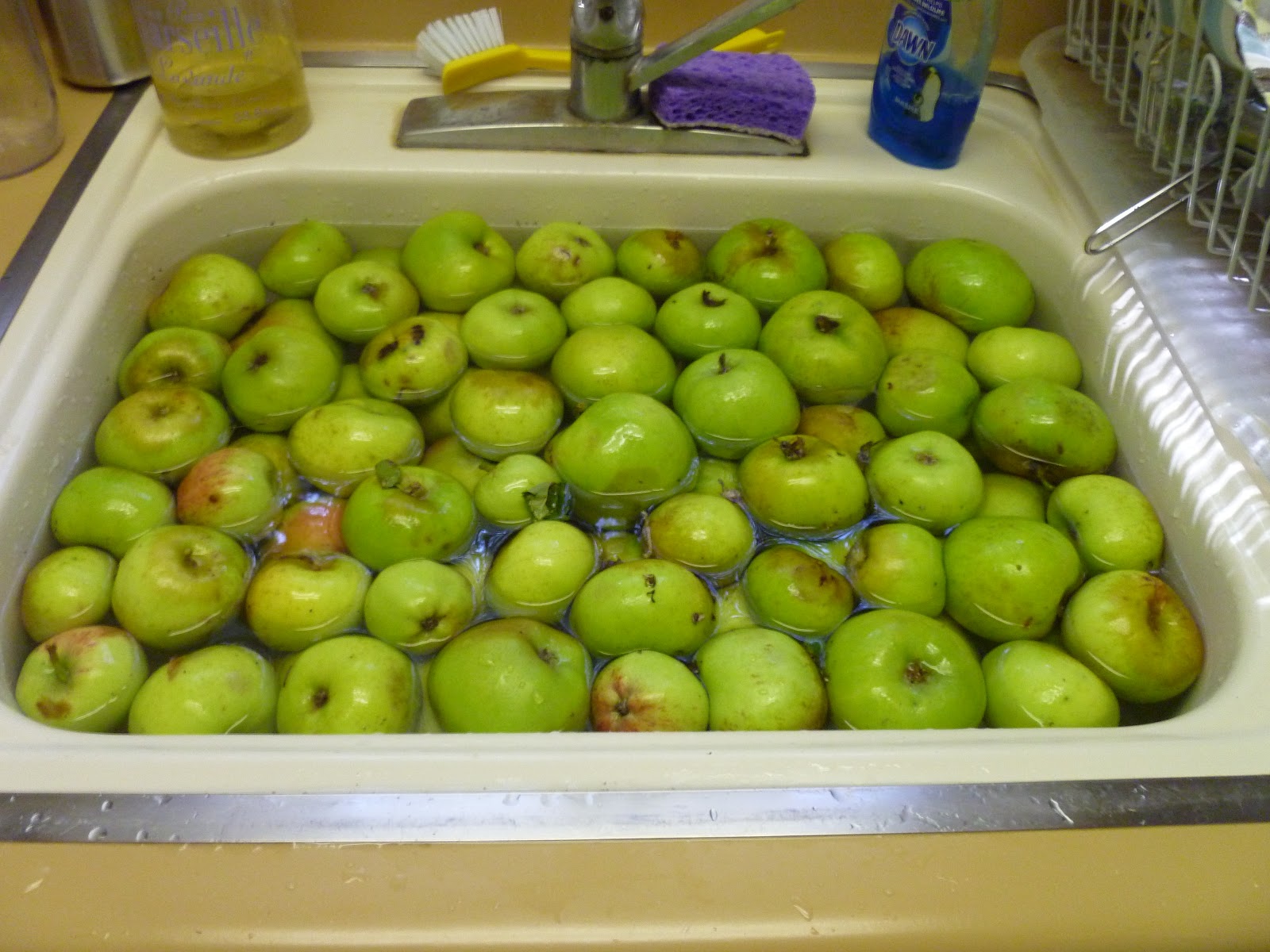
I separated the whole, perfect fruit -- which will keep in the fridge for months -- from the apples with broken skin, worm holes, and other blemishes. About half and half. I then cleaned the damaged fruit meticulously:


and peeled, cored, and chopped it all for applesauce, a process that took over three hours (and that was before I even started cooking)!

Applesauce and apple pie were among the first things I remember learning to cook as a child. I've tried countless recipes over the years, and my current favorite applesauce is inspired by a centuries-old cookbook, the Livre fort excellent de Cuysine (Lyons, 1542).


It offers the following recipe for apple tarts:

Red tarts.
To make red apple tarts, peel your apples and soak them in red wine & sugar & ground cinnamon with a little fresh butter and pass it all through a sieve and make your tarts.

The combination of red wine and apples is seductively grown-up; the apples benefit from a little acidity, and they turn the most gorgeous color, anywhere from deep rose to burgundy, depending on how much wine you use.  For this many apples I used one bottle of wine (that's all I had on hand; that quantity could have taken up to two bottles). A little sugar and cinnamon (I don't like my applesauce too sweet), but I skipped the butter; cooked the apples down until they were very soft, and then instead of sieving it, used an immersion blender to puree the mixture.

I canned ten pints of applesauce.  It is delicious to eat on its own, and can also go straight into a pie crust for "red tarts."


The possibilities for apples in desserts and pastries are, of course, virtually endless, and the apples are delicious to eat on their own. But in the last couple years I've started to look for ways to incorporate my bountiful harvest into savory dishes, too.  One of my favorites is a Normandy-inspired braise of chicken legs and and apples in hard cider, finished with cream (a take on this recipe).  Two more favorites come from yet another early modern francophone source, the Ouverture de Cuisine of Lancelot de Casteau (Liège, 1604).

I picked this up years and years ago in a used bookstore in my old neighborhood in Berkeley. It's a facsimile of the original printed edition, and the first piece in my growing collection of historical cookery texts.


Hungarian-style capon pottage.
Take a par-cooked capon, cut it in quarters, and fry it in butter just a little, so that it does not blacken; then take onions cut in slices, and apples cut in little quarters, and fry them in the butter, and pour them over the capon in a pot; then put in some broth and some wine, and let it boil some more, and put in saffron, sugar, nutmeg, and pine nuts, and stew it well so that it is well cooked, and serve it.


This "pottage" comes out like a thick stew, though you can add more broth if you want it more soup-like. Capon, though delicious, is pretty hard to come by, so I make this with chicken (and chicken broth and white wine).  I also often substitute olive oil for some or all of the butter, and I like to toast the pine nuts for a little extra flavor and texture.  I add them to the stew only right before serving, and save a few for garnish. It is delicious served over rice.

Sausages in pottage.
Take the sausages, and fry them in butter, then take five or six apples peeled and cut in little quarters, and four or five onions cut in round slices, and fry them in butter, and put all of it in a pot with the sausages, and put in nutmeg, cinnamon, white or red wine, sugar, and stew it all together in this way.


Although M Casteau lived an age before mashed potatoes found their way to the European table, he would no doubt have found, given the opportunity to try it, that purée de pommes de terre goes splendidly with this sausage-and-apple stew. A few days ago I needed a potluck dish for a party. I immediately thought of this satisfying stew, then realized that my contribution needed to be finger-food. So I converted it into a pie. I took the sausages out of their casings (these were boar sausages from a hunter friend -- delicious!) and browned the sausage meat, then removed it and sauteed minced onions and diced apples. I added the sausages back to the pan along with the red wine and spices, and cooked until the apples were slightly softened (but not falling apart), and let it cool while I whipped up some whole wheat pâte brisée (tart dough). I used a mini-muffin tin to form bite-sized pies. But I forgot to take a picture before they all got eaten up!

Thursday, September 20, 2012

Ladies Who Lunch

I'm taking advantage of the last few days of summer break to catch up with friends I don't often have time to see during the school year.  Today it was luncheon al fresco with fabulous Alicia.  I decided to keep things simple: soup and salad.

The soup was creamy cauliflower (deceptive because no cream is actually involved).  Sauté some chopped onion and garlic in olive oil until just golden, then add head of cauliflower, roughly chopped, and sauté that for a few minutes longer.  Then add enough water just to cover.  Add salt, white pepper, a bay leaf and fresh thyme leaves.  Cover and simmer for 15-20 minutes or until the cauliflower is very tender.  Remove the bay leaf, puree until smooth (I use an immersion blender), adjust seasonings.

The soup has a rich and velvety texture; if you really want to gild the lily, you can use chicken broth instead of water, or finish the soup with a drop of cream, but honestly, it is so luxurious that it doesn't need it.

I served the soup hot, but it's also good cold -- reminiscent of vichyssoise (another one of my favorites).


I whipped up a pesto to garnish the soup (despite its loveliness, it wants a little color and texture contrast).  Toasted almonds, parsley, parmesan cheese, garlic, olive oil, salt and pepper.


Of course no soup-and-salad meal is complete without home-baked bread.  (My go-to recipe calls for all-purpose flour; I usually use two parts AP and one part whole wheat for a heartier loaf. Today's loaf uses the same "white whole wheat" flour I used in the cobbler recently; it definitely works better in bread than in pastry, but for some reason it didn't rise as well as my usual mix.)


The main dish was a Niçoise salad, one of my summertime staples.  It's very easy but it has so many components that I rarely make it just for myself.

I usually use canned tuna (oil-packed, to be sure) when I make this salad.  But a few weeks ago I got my hands on some beautiful fresh albacore; I bought more than I could use and froze some of it.  So I decided to try poaching it in olive oil, following these directions.  It was very simple and the fish was moist and flavorful.  And the oil won't go to waste; strained and refrigerated, it should keep some weeks and can be used to poach a new batch of fish.  (At least that will be my experiment!)

Dressing: Dijon mustard, lemon juice, olive oil, minced shallot, salt and pepper.

Tomatoes, green beans, potatoes, niçoise olives, hardboiled eggs (from Fogline Farm), tuna, anchovies on a bed of lettuce.
Alicia brought dessert, which is always a treat -- not only is she an accomplished cook and serious all-around foodie, she used to be a professional pastry chef!  She made a luscious lemon pound cake and topped it with fresh strawberries made extra decadent by a splash of stravecchio balsamic vinegar (the real stuff from Modena; the balsamic that every other "balsamic" wants to be when it grows up).  Simple but extraordinary.


A lovely meal on a lovely day.

Saturday, September 8, 2012

Labor Day Desserts

I went to a barbecue over Labor Day weekend and volunteered to make dessert.

One of my neighbors has an overabundant peach tree, and was kind enough to give me several pounds of beautiful ripe fruit while it was in season.  My favorite thing to do with excess peaches is to cook them into cobbler filling (add a squeeze of lemon juice, a bit of sugar, and some cornstarch, simmer for about five minutes) and then jar them for later use.  You can have a taste of summertime even in the middle of a freezing winter!


The real genius of this cobbler recipe, though, is the crust.  I use a recipe published in Gourmet Magazine (dear, departed, well-beloved Gourmet Magazine!) in the early 1990s.  It was the first cobbler I learned to make, and though I've tried other versions, none has approached this one in texture, flavor, or ease of preparation.  The secret:


The crust is made with whipped cream.  No butter, no shortening -- just heavy cream that has been whipped to stiff peaks.  Fold it delicately into the dry ingredients (flour, sugar, baking powder) and you're done.  It comes out beautifully light and fluffy.  It also works beautifully for making sweet biscuits or strawberry shortcake.

I normally use all-purpose flour for this, but when I went to the grocery store they had run out of my preferred unbleached AP. This is King Arthur's "white whole wheat" -- it is, as you can see, darker and wheatier than AP, but light enough for baking and very tasty.  It is also drier and heartier than AP so I had to use extra cream to get the texture right.
hot out of the oven

There was a last-minute request for a gluten-free dessert, so I also whipped up a simple but delicious fruit crisp:

Sliced plums and blueberries tossed with raw sugar, ground ginger, cinnamon
Topping: rolled oats, ground almonds, ground walnuts, brown sugar, cinnamon, melted butter


The finished products!  Both served with vanilla ice cream.

Friday, August 31, 2012

Foodie Year in Review

Of course the year is not quite over -- 2012 still has a good few months left in it -- but I might as well get these up now, while I have time and am thinking of it and before the school term starts up and things get crazy again.  Here are some of my favorite things since the start of the year:

New Year's menu at my parents' house. This is how we roll. (Once a year, at any rate.)

Easter brunch: just-picked asparagus, baby beets, crumbled ricotta salata.


I found a cardoon at the market! Look how enormous it is!


After pulling off the leaves and cutting the stalks into manageable portions, this is what was left.

And after trimming away the spongy outsides and getting down to the tender, edible heart, this is all that was left. I braised it in chicken broth, with garlic and fresh herbs; delicious.

My dad's university offers a cooking class for undergrads, and my mom is one of the instructors. One of my visits coincided with the Italian food class, so I checked it out. Project of the day: breaking down an ENTIRE WHEEL of Parmiggiano-Reggiano cheese. Fantastic!!


If only blogs could convey smell...when the wheel was cracked open, the whole room filled with that delicious, nutty, creamy Parmesan aroma. It was glorious.

A gift of plums from a coworker's tree: baked into a tart with frangipane. A big hit at the 4th of July picnic.

On my last visit to my parents I got to raid their garden for all this spectacular summer produce...

Several varieties of tomatoes and peppers, squash blossoms, every kind of herb...

The rainbow chard and new potatoes went into this lentil soup (a favorite family recipe). Seasoned with lemon juice and mint, also from the garden!

Delicious white nectarines from mom and dad's tree -- they made a killer sorbet.

One of my favorite tricks, which I learned on my last trip to France about six years ago: use a vegetable peeler to make "noodles" of tender young zucchini. These are tossed with toasted pine nuts, garlic, thyme, parsley and olive oil.
I'll try to update this thing on a more regular basis from now on.  Buon appetito!